


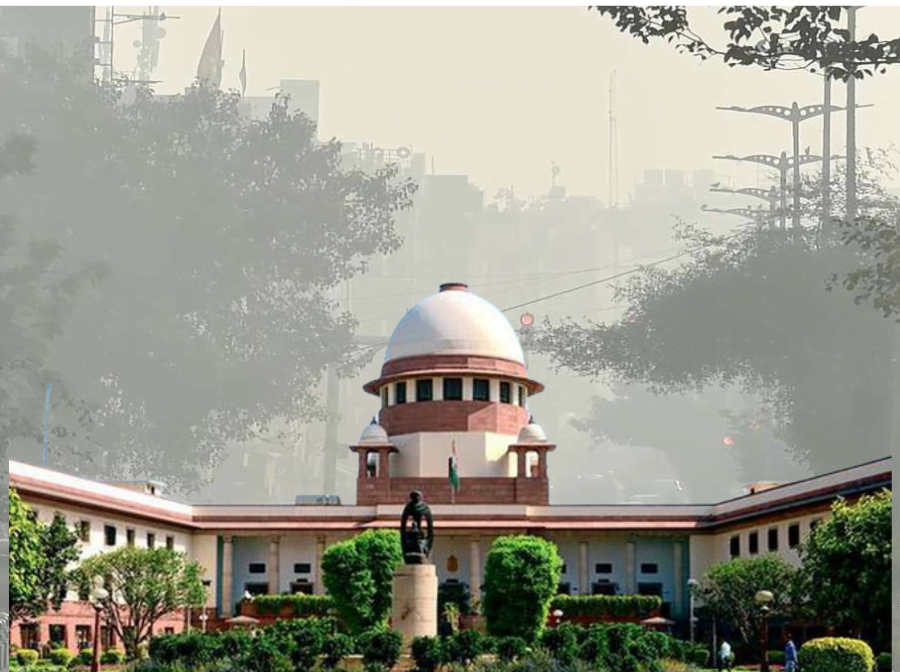
The Supreme Court of India has issued a stern warning to the Commission for Air Quality Management (CAQM) and the central government over the persistent issue of air pollution in Delhi and the National Capital Region (NCR). During a hearing, the Court expressed its frustration with the authorities, criticizing the lack of visible progress despite multiple directives over the years.

Chief Justice of India (CJI) D.Y. Chandrachud, leading the bench, questioned why pollution levels in Delhi have not significantly improved, especially given that stubble burning—one of the key pollution sources—is not currently a factor. The Court expressed concern that despite loud proclamations by the authorities and CAQM’s formation to tackle this issue, air quality remains hazardous, posing severe health risks to residents.
CAQM Criticized for Inefficiency
The Supreme Court’s primary criticism was directed at CAQM, which was formed to monitor and implement air quality improvement measures across the region. The bench, including Justice Sanjay Kaul, noted that CAQM appears to lack enforcement power and has failed to take concrete steps to reduce pollution levels. Justice Kaul remarked that the commission, despite having 20-30 members, has been largely ineffective, leading the Court to consider the need for extraordinary measures.
The Court also took issue with the lack of compliance on vehicular and industrial pollution controls. It emphasized that while stubble burning is often blamed for Delhi’s deteriorating air quality, vehicular and industrial emissions remain major contributors year-round. The Court asked why these two sectors have not been addressed more aggressively.
24-Hour Ultimatum to the Centre
In a bid to accelerate action, the Court issued a 24-hour ultimatum to the Centre and the CAQM to present concrete steps for tackling industrial and vehicular pollution. CJI Chandrachud warned that if the authorities fail to show results, the Court would be forced to step in with stricter judicial intervention. This ultimatum follows years of policy inaction and enforcement gaps.
Centre’s Response
Solicitor General Tushar Mehta, representing the central government, requested more time to respond, arguing that authorities were already monitoring air pollution measures closely. He assured the Court that there was no need for an additional task force and that a full report on the implementation team and their actions would be submitted shortly. However, this assurance did little to placate the Court, which insisted on seeing results immediately.
Broader Implications
Delhi has long struggled with air pollution, especially during the winter months when crop stubble burning, combined with industrial and vehicular emissions, creates a toxic haze over the city. Although stubble burning has been widely publicized as a major cause, experts agree that year-round sources like vehicle exhaust, dust, and industrial smoke play a more consistent role in the city’s hazardous air quality.
In previous years, the Court has taken steps such as banning construction activities and imposing fines for violating pollution norms. Yet, these measures have often been temporary and limited in scope. The current warning signals that the Court is prepared to impose harsher, long-term solutions if the authorities fail to act swiftly.
Conclusion
The Supreme Court’s rebuke of the Delhi Air Quality Panel and the central government underscores the urgent need for more effective and sustained measures to tackle pollution in the capital. With winter approaching and pollution levels set to rise again, the Court’s ultimatum may mark a turning point in the battle against Delhi’s air crisis. How the Centre and CAQM respond in the next 24 hours will be critical in shaping the future course of this decades-long issue.
The authorities must take immediate action to address vehicular and industrial pollution while implementing long-term strategies to safeguard public health in Delhi and the NCR(Hindustan Times)


















Comments 4