

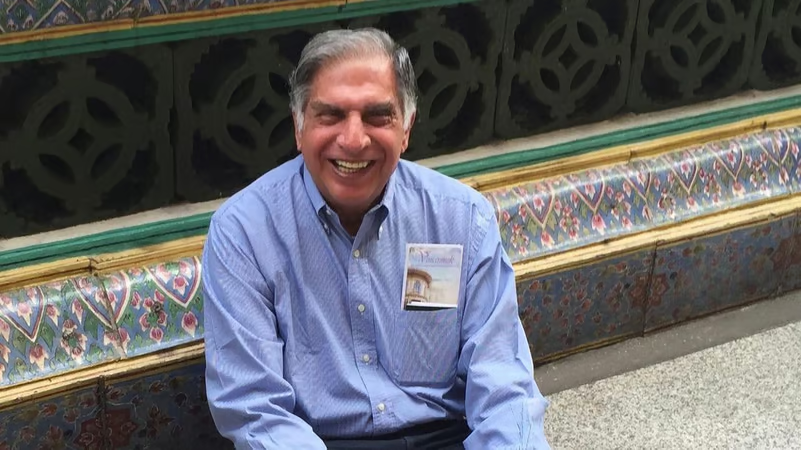
Ratan Tata, one of India’s most iconic industrialists, is known for his leadership, vision, and philanthropy. His journey is filled with inspiring stories that showcase his business acumen, values, and dedication to the nation’s progress. Below is a collection of some of the most memorable moments from his life that highlight his legacy.

1. The Humble Beginnings: Ratan Tata’s Early Life and Education
Ratan Tata was born on December 28, 1937, in Mumbai, to one of India’s most respected business families. However, his upbringing was marked by a difficult phase after his parents’ separation when he was just ten years old. Raised by his grandmother, Lady Navajbai Tata, Ratan grew up in a nurturing yet disciplined environment.
Despite his family’s wealth and stature, Tata’s early life taught him humility and the importance of hard work. He pursued his education in the U.S., graduating from Cornell University in 1962 with a degree in architecture. He later attended the Harvard Business School’s Advanced Management Program, which helped shape his business mindset.
2. Taking the Reins at Tata Group
Ratan Tata joined the Tata Group in 1962 and started his career on the shop floor of Tata Steel, working alongside blue-collar workers in Jamshedpur. This experience laid the foundation for his people-centric leadership style, one that would emphasize equality and respect for every worker in the organization.
In 1991, Ratan Tata succeeded J.R.D. Tata as the chairman of the Tata Group. This transition was not easy, as many within the company were skeptical of his leadership. Yet, over the next two decades, Ratan Tata proved himself to be an exceptional leader, transforming Tata Group into a global powerhouse.
3. The Launch of Tata Indica: A Risk That Paid Off
One of Ratan Tata’s boldest moves was the launch of the Tata Indica in 1998, India’s first indigenously designed and manufactured car. Many were skeptical of this decision, and the Indica initially faced tepid reviews and slow sales. However, Tata’s belief in the product never wavered. He made necessary modifications based on customer feedback, and soon the Indica became a success, revolutionizing India’s automobile industry.
This venture was a personal challenge for Ratan Tata. The failure of Indica would have put a dent in his leadership, but he stayed committed, demonstrating his resilience and his ability to adapt. His success with the Indica positioned Tata Motors as a strong player in the automotive industry.
4. The Acquisition of Jaguar Land Rover
One of the most remarkable business achievements during Ratan Tata’s tenure was the acquisition of two iconic British brands, Jaguar and Land Rover, in 2008. Tata Motors purchased the struggling luxury car brands from Ford, a move many considered risky, given the global economic crisis at the time.
Under Tata’s leadership, Jaguar Land Rover (JLR) not only survived but thrived, with record-breaking profits in the years following the acquisition. Tata’s decision was praised globally as a masterstroke, showcasing his vision of transforming Indian businesses into global brands. Today, JLR is one of Tata Motors’ most valuable assets.
5. Creating the World’s Cheapest Car: The Tata Nano
Ratan Tata’s vision of producing an affordable car for the common man came to life with the launch of the Tata Nano in 2008. Priced at just ₹1 lakh (approximately $2,000), the Nano was a revolutionary product in the global automotive industry. It was a part of Tata’s vision to make mobility accessible to millions of Indians.
Although the Nano didn’t achieve long-term commercial success, it demonstrated Tata’s ability to innovate and think outside the box. The car’s introduction was a significant moment in the automotive world, and it reinforced Tata’s desire to uplift ordinary Indians and improve their standard of living.
6. Philanthropy and Social Initiatives
Beyond business, Ratan Tata is known for his philanthropic contributions. A significant portion of Tata Group’s profits goes to charitable trusts, supporting education, healthcare, rural development, and the arts. Under Ratan Tata’s leadership, the company’s ethos remained deeply rooted in social responsibility.
One of the notable contributions was the Tata Trusts’ involvement in the healthcare sector. From setting up cancer hospitals to launching initiatives aimed at rural healthcare improvement, Tata’s philanthropic efforts have touched the lives of millions. Ratan Tata’s emphasis on corporate social responsibility is a cornerstone of his legacy.
7. Handling the 26/11 Mumbai Attacks
The 26/11 terrorist attacks in Mumbai in 2008 were one of the darkest days in Indian history. The iconic Taj Mahal Palace Hotel, owned by the Tata Group, was one of the primary targets. In the aftermath, Ratan Tata’s response was a testament to his leadership.
Tata personally oversaw the rehabilitation of the hotel and the welfare of the employees and families affected by the attack. Under his leadership, the group ensured that all medical and financial support was provided to the victims. His compassion and determination to rebuild the Taj Hotel as a symbol of resilience earned him immense respect.
8. Advocacy for Startups and Young Entrepreneurs
In his post-retirement years, Ratan Tata has become an influential figure in the Indian startup ecosystem. Despite stepping down as the chairman of Tata Group in 2012, he has remained active, investing in and mentoring various Indian startups like Ola, Paytm, UrbanClap, and many more.
Tata’s interest in fostering innovation and entrepreneurship reflects his commitment to India’s future. His investments have provided much-needed capital to fledgling companies and startups, furthering his legacy of promoting business and progress in India.
9. Ratan Tata’s Leadership Style
Ratan Tata is often described as a quiet and modest leader. He avoided the limelight and was known for his ethical business practices. His leadership style emphasized humility, integrity, and a commitment to the greater good. Unlike many corporate leaders, Tata never sought personal gain; his focus remained on the welfare of the nation and the Tata Group’s employees.
He has always maintained that “leadership is not about being popular; it’s about being right.” His understated demeanor belies the strength of his convictions, and he has often made bold decisions in the face of adversity.
10. Personal Life: A Man of Simplicity
Ratan Tata has always been a private individual. Despite his immense wealth, he leads a simple life, staying away from extravagance. He is known for his love of animals, particularly dogs, and often shares heartwarming posts on social media about his pets. This aspect of his life has endeared him to millions, who admire him for his humility.
Tata’s personal anecdotes, such as traveling to the U.S. to pursue his education on a modest scholarship or his deep connection with his grandmother, reflect his grounded upbringing and strong moral values.
Conclusion: A Legacy of Vision, Compassion, and Integrity
Ratan Tata’s life is a testament to vision, determination, and compassion. His leadership transformed Tata Group into a global conglomerate, with interests spanning from steel and automobiles to telecommunications and software. Yet, it’s his human side—his unwavering commitment to social causes and philanthropy—that sets him apart from many corporate leaders.
Through his bold business decisions, philanthropic initiatives, and humble lifestyle, Ratan Tata has earned a place in the hearts of millions. His legacy will continue to inspire generations of entrepreneurs and business leaders to pursue not just success but also values-driven leadership. The world has seen industrialists, but few possess the ethical compass and generosity that Ratan Tata embodies.