


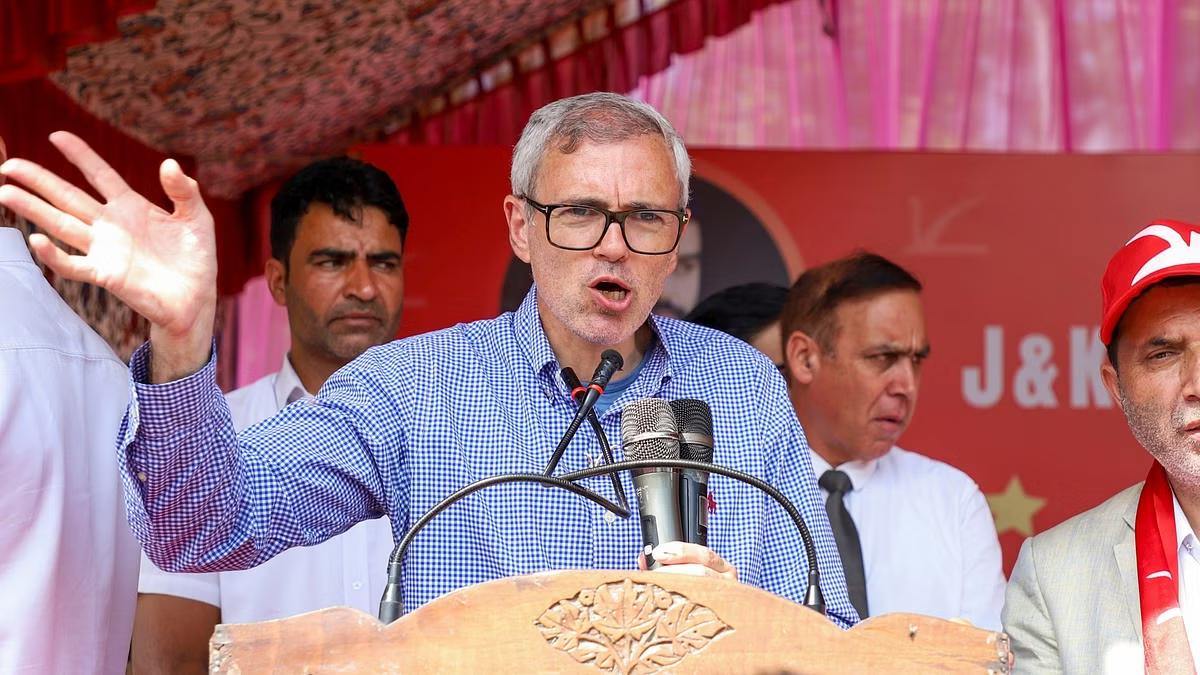
In a significant political shift, the revocation of President’s Rule in Jammu and Kashmir (J&K) has paved the way for the formation of a new government, marking the return of democratic governance in the Union Territory after years of direct central control. This change follows the recent Assembly elections in J&K, the first since the abrogation of Article 370 in 2019, which had stripped the region of its special status and bifurcated it into two Union Territories — J&K and Ladakh.

The National Conference (NC) leader, Omar Abdullah, is set to assume the role of Chief Minister, leading a coalition government comprising his party and the Congress, supported by independent legislators and one Aam Aadmi Party (AAP) MLA. This political arrangement emerged after the NC secured 42 seats in the Assembly, while Congress won six seats. The opposition Bharatiya Janata Party (BJP) became the second-largest party with 29 seats, making this election highly competitive.
The Revocation of President’s Rule
The formal process to revoke President’s Rule involved a presidential notification signed by President Droupadi Murmu. This notification follows the approval of the Union Cabinet, marking the end of central administration in the region. President’s Rule was first imposed in J&K in 2019 after the collapse of the PDP-BJP coalition and the revocation of Article 370. Since then, the Union Territory had been under direct central control, which included the suspension of its Legislative Assembly under Section 73 of the Jammu and Kashmir Reorganisation Act.
Why Was President’s Rule Imposed?
The imposition of President’s Rule in 2019 was primarily triggered by political instability following the dissolution of the coalition between the People’s Democratic Party (PDP) and the BJP. The region then experienced a period of Governor’s Rule, which lasted six months. Afterward, the Union Government extended central control through President’s Rule, ensuring that the region could be governed in the absence of a functioning state government.
Moreover, the abrogation of Article 370 and the reorganization of J&K into a Union Territory necessitated the continuation of President’s Rule to manage the complex transition. The region was not only facing political uncertainty but also an evolving security situation. Over the past five years, President’s Rule has been extended several times to maintain stability and security in the sensitive region.
The Importance of Lifting President’s Rule
The removal of President’s Rule is a crucial step toward reinstating full democratic governance in J&K. With the region’s political landscape redefined after the abrogation of its special status, it now returns to an elected government for the first time in five years. This development has been widely anticipated as a move to restore normalcy and democratic processes in the Union Territory. Omar Abdullah’s government will now take on the responsibility of steering J&K through its post-Article 370 reality, with key issues like the demand for statehood expected to take center stage.
The Role of the NC-Congress Coalition
The NC-Congress coalition brings together old political partners, having previously governed J&K from 2009 to 2014. Omar Abdullah’s leadership during that time is expected to provide continuity in some areas, while also addressing the region’s changed status. His government is likely to focus on pushing for the restoration of J&K’s statehood, a demand that has gained momentum in the political discourse. Abdullah has already indicated that one of the first priorities of his government would be to pass a resolution in the Assembly calling for the restoration of statehood, which would be forwarded to the central government for consideration.
Assembly Elections and Future Challenges
The recently concluded Assembly elections, held in three phases in September and October 2024, were a historic event, as they were the first since the revocation of Article 370. The elections saw significant voter participation, reflecting a keen interest in re-establishing a democratic government in the region. However, challenges remain, particularly in terms of balancing governance with the region’s complex security dynamics.
The Abdullah-led government will face numerous challenges, including addressing the aspirations of both Jammu and Kashmir regions, dealing with security concerns, and navigating the economic and social development of the Union Territory. Moreover, political observers expect continued tension between the new coalition government and the BJP, which has a strong foothold in Jammu and will act as the principal opposition in the Assembly . India Today.
Conclusion
The withdrawal of President’s Rule from Jammu and Kashmir is a monumental development in the region’s recent history. It signals the return of electoral democracy and local governance after years of direct central control. With Omar Abdullah at the helm, the new government is expected to address the significant political, social, and economic challenges facing J&K. This event also marks a key moment in the ongoing debate over the future of J&K’s political status, with statehood likely to be one of the top priorities for the incoming administration. As the region transitions from central administration to an elected government, the road ahead will require careful balancing of political aspirations, security needs, and developmental priorities.













Comments 3