


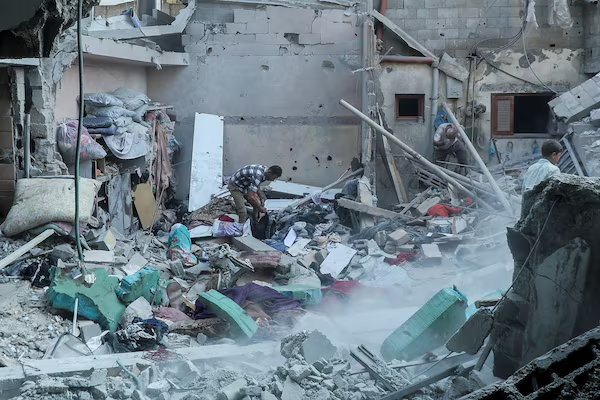
The airstrikes carried out by Israeli forces in Gaza continue to generate shockwaves around the world, with the death toll from one of the latest attacks reaching 33 Palestinians, including 21 women. This rise in civilian casualties adds to the mounting humanitarian crisis in Gaza, where hundreds of thousands of residents are caught in the crossfire. Reports indicate that many victims remain trapped beneath the rubble of collapsed buildings, raising fears that the number of fatalities could climb even higher.

The latest escalation in violence follows the targeted killing of Yahya Sinwar, a prominent Hamas leader. Sinwar, one of the key architects of the devastating October 7 Hamas attacks on Israel, was a top priority for Israeli forces. His death, while celebrated in Israel, has triggered an intensified military response from both sides. Hamas has vowed retaliation, further complicating efforts to de-escalate the situation.
Why Israel Continues Its Offensive
Despite Sinwar’s death, Israel has maintained a firm stance on continuing its military operations in Gaza. Israeli Prime Minister Benjamin Netanyahu and Defense Minister Yoav Gallant have reiterated that the offensive will persist until Hamas’ military infrastructure is dismantled. They argue that Hamas militants, who continue to fire rockets at Israeli cities, are using civilian buildings as shields, complicating efforts to avoid non-combatant casualties.
However, the toll on Gaza’s civilian population has prompted widespread condemnation from international observers. Human rights organizations have raised concerns over the proportionality of Israel’s military response, accusing the Israeli Defense Forces (IDF) of employing indiscriminate airstrikes in densely populated areas. According to the United Nations, more than 2,400 civilians, including women and children, have died since the conflict’s recent escalation. Calls for a ceasefire have intensified, but Israel remains steadfast in its resolve.
Global Reactions and Calls for Peace
The international community is deeply divided on the issue. While many Western nations, including the United States and the European Union, affirm Israel’s right to self-defense, they also stress the importance of minimizing civilian harm. The U.S. has provided extensive military and intelligence support to Israel during this ongoing conflict, but President Joe Biden has also urged Israeli leaders to take necessary precautions to limit civilian casualties.
On the other hand, countries such as Turkey, Iran, and Qatar have vocally criticized Israel’s actions, calling for an immediate cessation of hostilities. In particular, Turkish President Recep Tayyip Erdoğan condemned Israel’s bombardment of Gaza, describing it as a violation of international law. The UN Secretary-General António Guterres has called the situation a “humanitarian catastrophe” and urged for both sides to agree to an immediate ceasefire.
Escalation in Lebanon and Broader Regional Impact
The conflict has also spilled over into neighboring Lebanon, where Hezbollah, an Iranian-backed militant group, has launched attacks on Israeli positions. The violence in Lebanon adds another dimension to the conflict, threatening to ignite a broader regional war. In the past 24 hours alone, at least 45 people have been killed in Lebanon, while hundreds of others have been wounded. This ongoing violence has led to the displacement of over a million people, with thousands fleeing across the Lebanon-Syria border.
The broader Middle East remains on high alert as international powers attempt to mediate a ceasefire and prevent the conflict from spreading further. The involvement of Hezbollah, alongside the growing humanitarian crisis in Gaza, has raised concerns about the stability of the region and the potential for the conflict to expand into a full-scale regional war.
Humanitarian Crisis in Gaza
The situation in Gaza has deteriorated rapidly as Israeli airstrikes continue to target what the IDF describes as key Hamas military positions. Gaza’s already crumbling infrastructure, including hospitals, water facilities, and schools, has been pushed to the brink of collapse. The Israeli blockade has further restricted the entry of essential supplies such as food, medicine, and fuel, exacerbating the suffering of Gaza’s civilian population.
UNICEF has expressed alarm at the number of children affected by the conflict. More than 400,000 children in Gaza have been displaced, and many are living in overcrowded shelters with little access to clean water and medical care. Gaza’s healthcare system is struggling to cope with the influx of casualties, and many hospitals are on the verge of running out of critical supplies.
International aid agencies have called for urgent humanitarian corridors to allow food, water, and medical supplies into Gaza, but negotiations have stalled amid ongoing violence. Israel insists that any relief effort must be closely monitored to prevent supplies from reaching Hamas fighters, while humanitarian organizations argue that innocent civilians are being denied life-saving aid.
Conclusion
The situation in Gaza remains grim, with no immediate end in sight. As the death toll continues to rise, international pressure mounts on both Israel and Hamas to halt the violence and seek a diplomatic solution. While Israel’s military campaign seeks to eliminate Hamas’ leadership and capabilities, the high civilian cost is causing outrage around the globe. Without significant diplomatic intervention, the conflict risks spiraling further into chaos, leaving countless innocent civilians trapped in the crossfire of a war with no clear resolution.


















Comments 5