


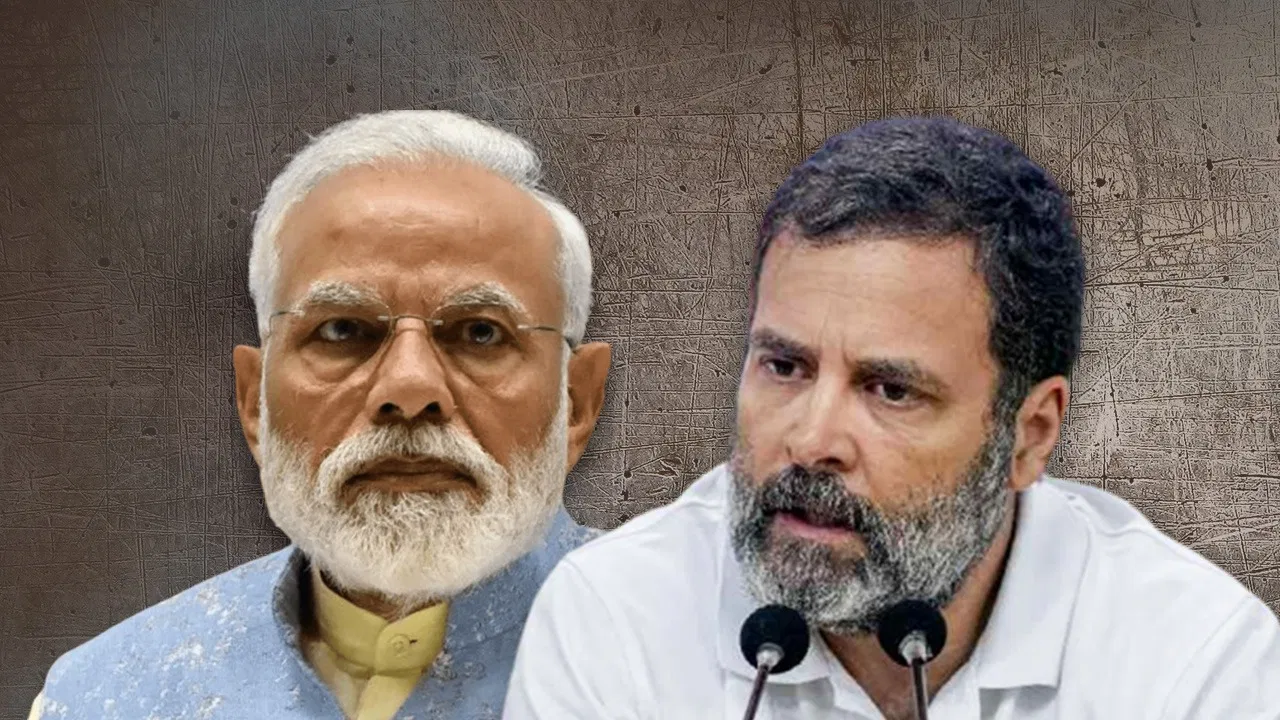
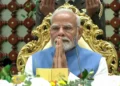
Prime Minister Narendra Modi, in a pointed attack on Congress leader Rahul Gandhi, accused him of “insulting India on foreign land” during a recent public address. The Prime Minister’s comments come in response to remarks made by Gandhi during his international tours, where he spoke critically of the Indian government’s policies and the state of democracy in the country. This latest exchange between two of India’s most prominent political figures underscores the intensifying political rivalry between the Bharatiya Janata Party (BJP) and the Indian National Congress (INC).

Modi’s Strong Criticism
While addressing a gathering of Indian diaspora, PM Modi did not hold back from taking a swipe at Rahul Gandhi and the Congress party, stating, “Some people are still stuck in the mentality of speaking ill of India on foreign soil.” Though Modi did not directly name Gandhi, his remarks were widely interpreted as a rebuke to the Congress leader’s recent comments abroad. Modi emphasized that such remarks harm India’s reputation on the global stage, and stressed that a true patriot would never defame their country, no matter the political disagreements.
Modi’s comment, “Congress insults India on foreign land,” sparked a flurry of reactions from both BJP supporters and Congress leaders, further fanning the flames of this ongoing political controversy. According to Modi, Gandhi’s remarks overseas about India’s democratic decline are not only inaccurate but detrimental to the country’s image, which is undergoing significant global transformation.
Rahul Gandhi’s International Critique
Rahul Gandhi, who has often taken his critiques of the Modi government beyond Indian borders, made several statements during his visits to Europe and the United States that questioned the state of democracy in India. He expressed concerns over the erosion of democratic institutions, the centralization of power, and the alleged suppression of dissent under Modi’s rule.
In particular, Gandhi has frequently spoken about issues such as press freedom, religious intolerance, and the targeting of opposition leaders by government agencies. His most recent international tour featured meetings with political leaders, intellectuals, and think tanks, where he reiterated his belief that democracy in India is “under assault” and needs to be restored to its former glory. Gandhi’s critiques have been a recurring theme of his speeches, not just within India, but also on international platforms.
Gandhi’s stance has earned him applause from some quarters for boldly raising concerns over democratic governance. However, it has also led to criticism, especially from Modi and his supporters, who argue that such comments tarnish India’s image and undermine its global standing.
BJP’s Response: National Pride and Political Strategy
The BJP has consistently pushed back against Rahul Gandhi’s statements abroad, framing them as an affront to India’s national pride. The party’s leadership has often accused Gandhi of betraying the country by airing grievances in front of international audiences. They argue that while political differences are acceptable in a democracy, airing such views on foreign platforms crosses a line. According to BJP leaders, Gandhi’s remarks give ammunition to India’s critics and hinder its diplomatic efforts.
PM Modi’s latest attack aligns with the BJP’s broader political strategy of invoking nationalism and portraying the Congress as out of touch with the aspirations of a resurgent India. Modi’s government has placed significant emphasis on improving India’s global image and strengthening its geopolitical standing. In this context, the BJP has framed criticism of the country’s policies on international stages as unpatriotic.
Congress’s Defense
In response to Modi’s remarks, Congress leaders have defended Gandhi’s right to speak out on issues affecting India’s democracy. They argue that Gandhi’s critiques are not aimed at undermining the nation but at safeguarding its democratic values. Congress has consistently maintained that the BJP government is stifling dissent, misusing institutions like the Enforcement Directorate and the Central Bureau of Investigation to target opposition leaders, and promoting a climate of fear.
Congress spokespersons have accused PM Modi of deflecting from the core issues raised by Gandhi, such as the decline in press freedom, growing religious intolerance, and the erosion of democratic checks and balances. They have reiterated that the BJP is more concerned with optics than addressing these legitimate concerns.
The Broader Political Context
This exchange between Modi and Gandhi is emblematic of the polarized political landscape in India as the country moves toward key elections in the near future. With several state elections approaching and national elections slated for 2024, the battle between the BJP and Congress is expected to intensify.
Modi’s government has garnered significant support, both domestically and internationally, for its handling of the economy, infrastructure development, and diplomatic engagements. However, opposition parties, led by Congress, have raised alarms about the centralization of power, rising unemployment, inflation, and growing intolerance under the BJP’s rule.
Gandhi, despite facing criticism for his political strategies, has emerged as a vocal critic of the Modi government. His international outreach is seen by some as an attempt to rebuild his image and position himself as a leader capable of taking on Modi’s BJP in the 2024 elections. Whether this strategy will pay off in a highly charged political environment remains to be seen.
Conclusion
The war of words between PM Modi and Rahul Gandhi is not just a reflection of personal animosity but also of the ideological battle being fought between the BJP and Congress. Modi’s nationalist rhetoric, combined with his developmental narrative, has resonated with a significant portion of the electorate. On the other hand, Gandhi’s emphasis on democratic governance and institutional integrity continues to strike a chord with those concerned about India’s future under the current government.














Comments 1