


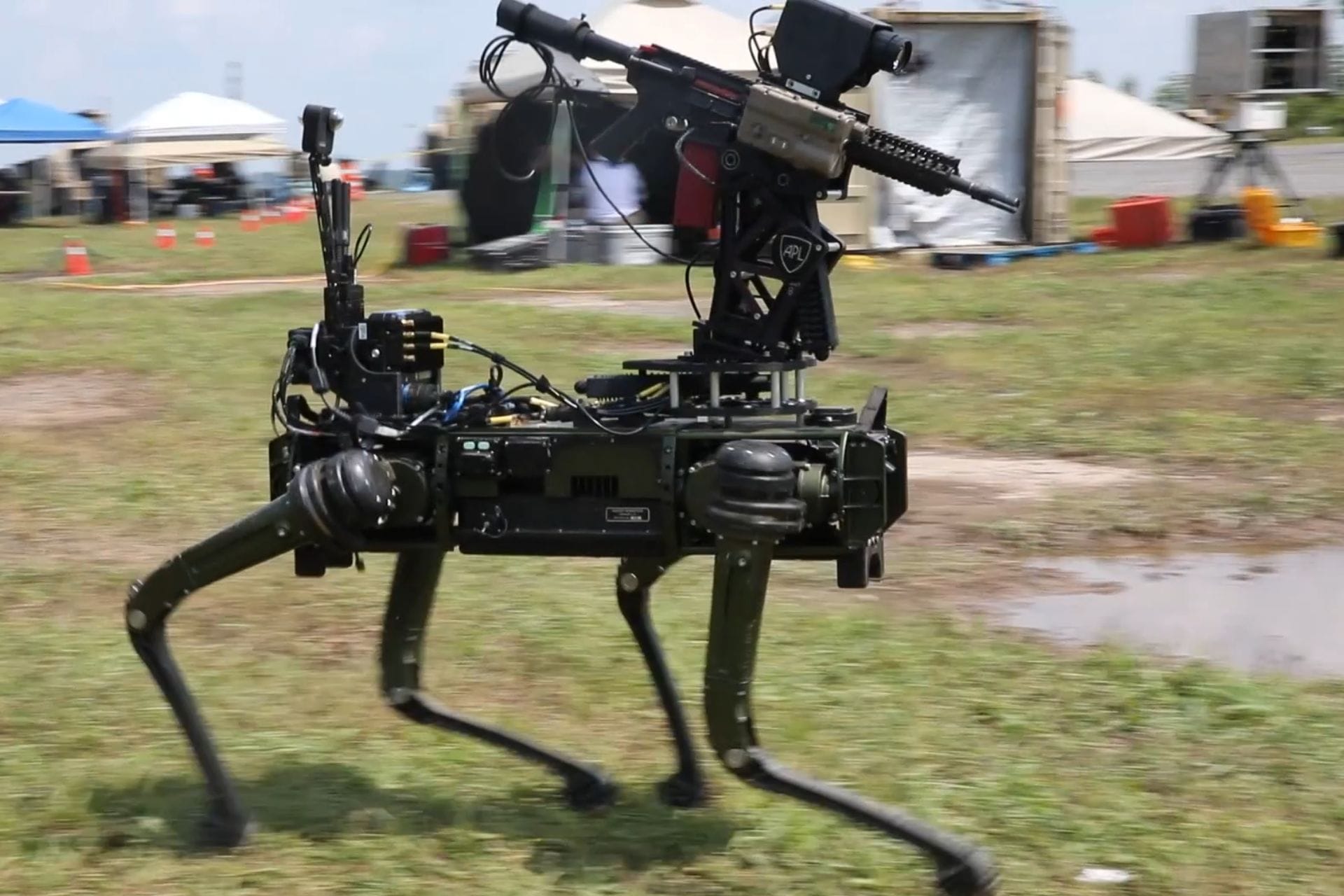
The U.S. Army recently conducted significant tests of robot dogs armed with AI-powered rifles at a military facility in the Middle East, a move that signals the evolving integration of artificial intelligence and robotics in modern warfare. The tests took place at the Red Sands Integrated Experimentation Center in Saudi Arabia, where these autonomous machines, equipped with advanced targeting systems, were evaluated for their potential role in counter-drone and perimeter security operations.

The Evolution of Robotic Military Assets
Robotic dogs, such as the Ghost Robotics Vision 60, are no strangers to military operations. Initially developed for reconnaissance and explosive ordnance disposal, these quadrupedal unmanned ground vehicles (Q-UGVs) have been utilized for various tasks, from navigating hazardous environments to collecting intelligence in areas unsafe for human troops. However, the recent upgrade to include an AR-15/M16-pattern rifle has propelled them into a new realm of military application.
These AI-enabled robot dogs are equipped with an electro-optical targeting system labeled “Lone Wolf,” which enhances their capability to autonomously detect and engage fast-moving targets. The U.S. Army has also explored the use of Onyx Industries’ SENTRY system on these robotic platforms, further demonstrating their adaptability in combat scenarios.
AI-Enabled Weaponry and Autonomous Decision-Making
One of the most crucial aspects of these robot dogs is their AI-powered guns. The incorporation of AI allows for precision targeting with minimal human intervention, reducing the risk to U.S. service members in high-threat environments like the Middle East. This is especially valuable in counter-drone operations, where quick response times and accuracy are critical. The AI can analyze drone movement, identify threats, and make real-time decisions about when to engage, often with greater efficiency than human soldiers.
These tests are part of a broader strategy to incorporate artificial intelligence into military tools, driven by a need to counter low-cost but increasingly dangerous drone technology being used by adversaries. The U.S. military has spent considerable resources using expensive surface-to-air missiles to shoot down drones, prompting the need for more cost-effective solutions, such as AI-guided robotic guns.
International Developments and Concerns
The U.S. is not alone in developing armed robotic dogs. China’s People’s Liberation Army has also experimented with similar models, showcasing versions equipped with QBZ-95 rifles during exercises. This international race to weaponize AI-powered robotics raises questions about the future of warfare, where autonomous machines could become central to combat.
Ethical and Strategic Considerations
While the advancements in robot dog technology are impressive, they come with significant ethical considerations. The potential deployment of autonomous robots capable of making life-or-death decisions without direct human oversight raises concerns about accountability and the rules of engagement in conflict zones. Critics argue that such systems could lead to unintended consequences or misidentifications in the heat of battle.
Despite these concerns, the Pentagon continues to explore these technologies as part of its broader “Replicator” initiative, which focuses on leveraging autonomous systems to reduce human risk and enhance combat effectiveness. However, Army officials have been cautious about their expectations, noting that these demonstrations are exploratory and do not necessarily signal immediate widespread deployment(The New York Sun).
Conclusion
The U.S. Army’s recent tests of AI-powered robot dogs armed with rifles represent a pivotal step in the ongoing integration of robotics and artificial intelligence into military operations. These machines offer the potential for increased efficiency and reduced risk to human soldiers, particularly in counter-drone operations and other high-risk scenarios. However, the rapid advancement of this technology also raises important ethical and strategic questions about the future of warfare and the role autonomous systems will play on the battlefield.