

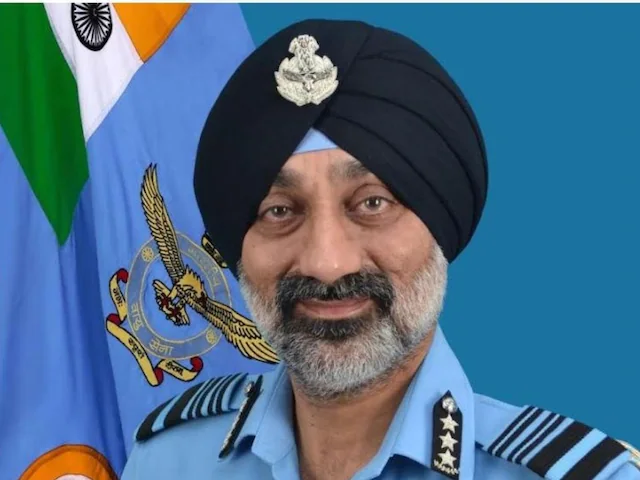
Air Marshal Amar Preet Singh has been appointed as the next Chief of the Indian Air Force (IAF), taking over from Air Chief Marshal Vivek Ram Chaudhari. With a distinguished career spanning over three decades, Air Marshal Amar Preet Singh brings with him vast operational experience and leadership skills that are critical as India navigates evolving security challenges.

Background and Career Highlights
Air Marshal Singh, currently serving as the Vice Chief of the Air Staff, is a highly decorated officer with numerous achievements to his credit. He was commissioned into the Indian Air Force in December 1984, specializing in fighter aircraft operations. His career has included significant operational, administrative, and instructional roles, covering various strategic positions that have honed his expertise in air warfare and defence strategies.
He has commanded numerous frontline bases and has extensive experience flying various fighter aircraft, including the Sukhoi Su-30MKI and MiG-21s. His operational background is complemented by his leadership roles in planning and executing critical missions for the Indian Air Force. He has also served in senior staff positions, focusing on modernization and capability enhancement of the force
Key Challenges Ahead
As the new Air Chief, Air Marshal Singh faces several pressing challenges, both internal and external. India’s security environment is becoming increasingly complex, with tensions along the northern borders with China and ongoing issues with Pakistan. The modernization of the Indian Air Force, which includes the induction of cutting-edge technologies like the Rafale jets and the development of indigenous platforms like the Tejas Light Combat Aircraft (LCA), will continue to be a priority.
Singh will also oversee the ongoing reforms in the IAF’s organizational structure, including the Theater Command initiative aimed at integrating the three services (Army, Navy, and Air Force) for more effective joint operations. As the geopolitical landscape shifts, Singh’s leadership will be crucial in ensuring that the Indian Air Force remains agile, capable, and ready to tackle any emerging threats
Strategic Vision for the IAF
Under Singh’s leadership, the Air Force is expected to continue its path towards becoming a more technology-driven force. His experience with fighter operations and air defense systems will be critical in steering the IAF towards enhancing its capabilities. With cyber threats and unmanned warfare becoming increasingly important in modern military operations, Singh is likely to focus on strengthening the IAF’s preparedness in these areas as well.
He will also play a key role in maintaining India’s air superiority and ensuring operational readiness, which will involve balancing technological upgrades with the need to maintain a robust fleet of aircraft. The continued integration of space and cyber capabilities into traditional air operations will be a focal point of his tenure as Air Chief
Personal Life and Recognition
Air Marshal Singh is a graduate of the prestigious National Defence Academy (NDA) and has attended various advanced courses, including the Defence Services Staff College (DSSC) and the National Defence College (NDC). His exemplary service has earned him numerous awards, including the Param Vishisht Seva Medal (PVSM), Ati Vishisht Seva Medal (AVSM), and the Vayu Sena Medal (VM) for his distinguished contributions to the IAF.
Known for his calm demeanor and strategic thinking, Singh has earned respect across the military for his professionalism and leadership. His appointment as the Chief of Air Staff is seen as a continuation of the strong leadership the IAF has had in recent years.
Conclusion
As Air Marshal Amar Preet Singh prepares to take over as the Chief of Air Staff, the Indian Air Force is poised to enter a new era of modernization and operational excellence. With his vast experience and strategic acumen, Singh is well-equipped to lead the IAF through evolving security challenges, ensuring that it remains a formidable force capable of safeguarding India’s interests both at home and abroad.