


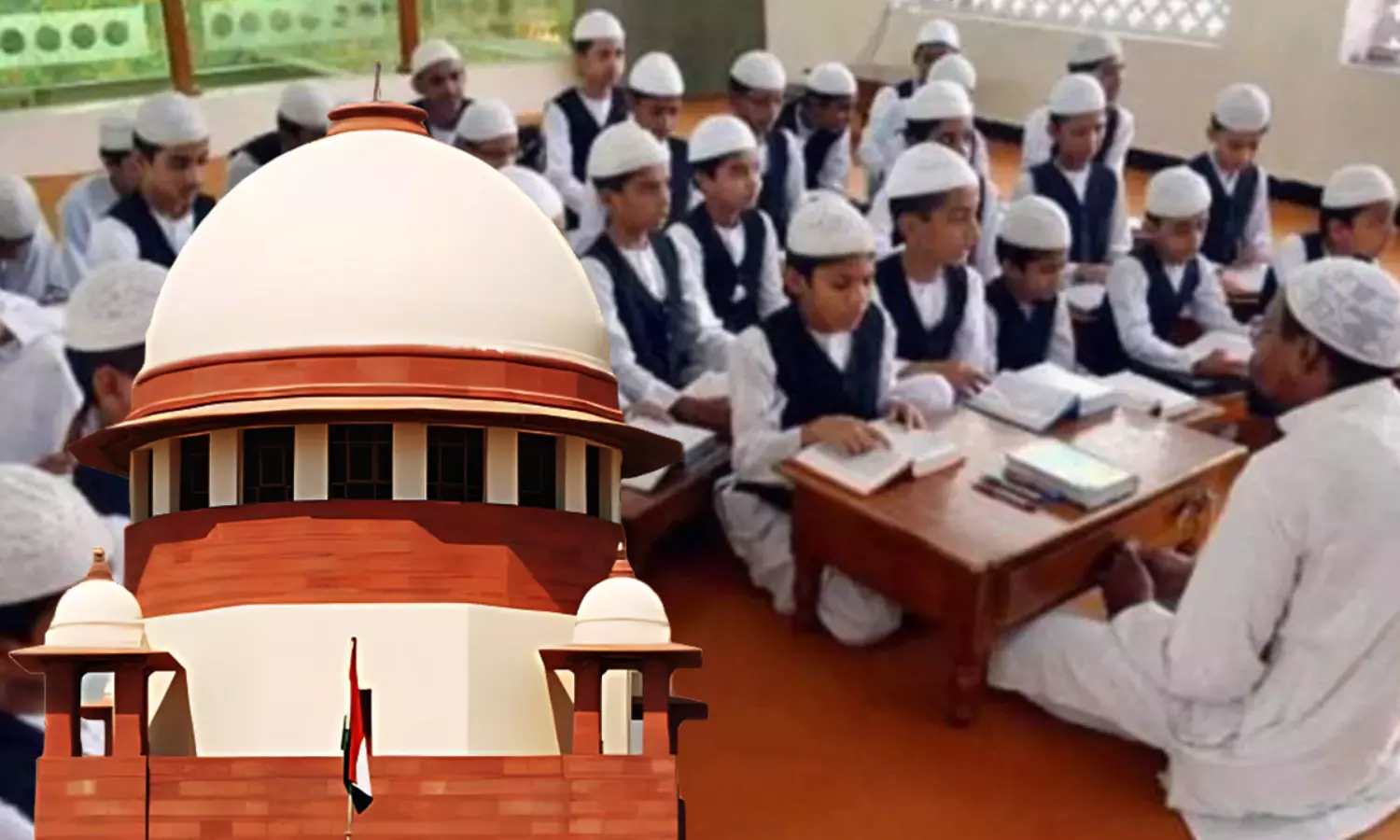
In a landmark decision, the Supreme Court of India upheld the Uttar Pradesh Madrasa Education Act of 2004, which mandates the regulation of madrasas across the state. The decision, delivered by a three-judge bench led by Chief Justice D.Y. Chandrachud, overturned an earlier ruling by the Allahabad High Court, which had deemed the Act unconstitutional and in conflict with secular principles. This ruling is significant for approximately 16,000 madrasas and impacts around 1.7 million students enrolled in these institutions across Uttar Pradesh.

Background of the Case
The Uttar Pradesh Madrasa Education Act was introduced in 2004 with the goal of establishing state oversight over madrasas in Uttar Pradesh. The Act empowers the state government to monitor educational quality in madrasas and introduce regulations for improving the curriculum and administration. Critics of the Act, however, argued that it undermines secularism by permitting a separate framework for religious schools, potentially alienating madrasa students from mainstream educational and employment opportunities.
In March 2024, the Allahabad High Court struck down the Act, arguing that it violated India’s secular framework. The Court directed the state government to integrate madrasa students into the formal schooling system, asserting that a common educational platform would better serve students’ interests and promote national unity. However, this ruling raised concerns among educators and religious leaders who worried about the future of Islamic education in the state and feared that this integration could erode cultural and religious identity.
Supreme Court’s Rationale for Upholding the Act
The Supreme Court’s decision highlighted several key principles that address the intersection of secularism and religious education. Chief Justice D.Y. Chandrachud, along with Justices J.B. Pardiwala and Manoj Misra, argued that the High Court’s ruling overlooked the importance of preserving cultural diversity within India’s secular framework. According to the Supreme Court, secularism in India is not synonymous with homogenization but rather accommodates diverse practices, including religious education within state-regulated parameters.
The Supreme Court’s decision emphasized the state’s right to regulate educational standards across all types of institutions, including religious ones. Chief Justice Chandrachud noted, “The state can regulate the standards of education in madrasas… regulations relating to the quality of education do not interfere with the administration of the madrasas.” This distinction allowed the Court to justify the Act on the grounds that state intervention ensures quality education while respecting religious diversity.
Reactions from Stakeholders
The ruling was met with mixed reactions. Supporters argue that it strikes a balance between maintaining the religious character of madrasas and ensuring that students receive a quality education, potentially opening up opportunities for them to enter mainstream careers. They believe that regulatory oversight will help madrasas adhere to certain educational standards, benefiting students by broadening their academic exposure. The Uttar Pradesh government and several educational associations praised the decision, stating that it provides much-needed clarity on the issue of religious education.
However, the ruling has also drawn criticism from some religious leaders and child rights advocates who worry that it may inadvertently curtail religious teachings. These critics argue that even indirect state interference may undermine the autonomy of madrasas and the traditional curriculum that forms the core of Islamic education.
Implications of the Ruling on Madrasa Education
The Supreme Court’s decision has far-reaching implications for madrasa education in Uttar Pradesh. By upholding the Act, the Court effectively allows madrasas to continue operating as religious educational institutions while adhering to state-mandated educational standards. Under the Act, madrasas will be required to incorporate subjects from the National Council of Educational Research and Training (NCERT) curriculum alongside traditional religious studies. This could potentially expand madrasa students’ educational horizons and prepare them for competitive exams and employment in various sectors.
Furthermore, the ruling reinforces the state’s role in overseeing the quality of education across all institutions, helping to bridge educational disparities. This move aligns with the government’s broader educational reform agenda, which includes making quality education accessible to all communities. By establishing a regulatory framework for madrasas, the Act aims to integrate madrasa students into the broader educational system without forcing assimilation, allowing them to retain their cultural and religious identity.
The Secularism Debate
The Supreme Court’s judgment also delves into the broader debate on secularism in India. Unlike in some other countries, where secularism strictly separates religion from public life, Indian secularism is built on the concept of “Sarva Dharma Sambhav,” or equal respect for all religions. This model does not require the exclusion of religious practices from public life but rather emphasizes coexistence within a pluralistic society. The Court’s decision reinforces this view, asserting that the regulation of madrasas is a means of inclusion rather than isolation.
Chief Justice Chandrachud argued that secularism should not be interpreted as a principle that alienates religious minorities from state policies and programs. He stated that a secular state must recognize the cultural and religious diversity of its people and support educational systems that reflect this diversity. This approach allows the state to promote educational standards while respecting the religious and cultural heritage of madrasa students, ensuring their rights to religious freedom are protected within the secular framework .The Logical Indian.
Potential Challenges and the Way Forward
While the ruling sets a precedent for the regulation of religious educational institutions, its implementation may present challenges. Ensuring compliance with state educational standards will require coordination between madrasa administrators and government officials. There may be resistance from certain religious factions concerned about potential limitations on the madrasa curriculum. To address these challenges, the government could consider collaborative efforts, involving religious scholars, educators, and administrators to find a balanced curriculum that incorporates both secular and religious studies.
Additionally, the state government may need to allocate resources for teacher training and curriculum development to support this integration effectively. Educators within madrasas may need assistance in adopting NCERT subjects alongside traditional teachings. By working closely with madrasa authorities, the government could facilitate a smoother transition and help establish a model for quality education that respects religious diversity.
Conclusion
The Supreme Court’s decision to uphold the 2004 Uttar Pradesh Madrasa Education Act reflects India’s unique secular approach, which seeks to balance religious education with educational quality standards. By affirming the state’s authority to regulate madrasas, the Court has ensured that approximately 1.7 million madrasa students can continue their education within a system that integrates both religious and secular subjects. This ruling not only preserves the cultural identity of these students but also promotes inclusivity, reinforcing the idea that secularism in India accommodates diverse religious practices within a unified educational framework.














69pkrgame has a decent selection of games. It’s worth checking out if you have some time to spare. Give it a look-see here: 69pkrgame
win2023bet1 looks like a new site. I’m always a bit cautious with new ones, but hey, gotta explore, right? Testing it out, will report back. The link’s here: win2023bet1
Bdggameowner … makes you wonder who owns it, right? Site looks clean and professional, but I couldn’t find much info about the actual company. Games are good, no complaints there. But do your research before putting too much in. Check out bdggameowner and see what you think.
CalupohCasino is worth checking out. It has a clean design and decent payouts. Might be your new favorite calupohcasino.
Jili123 ph, I’ve heard rumblings! Time to see if it’s legit. Hoping for a smooth experience and some winnings! Let’s goooo using jili123 ph
Okay, Jilibet and Donnalyn, you have my attention! What kind of surprises are in store for us? I’m diving in to jilibet donnalyn to find out!
Just tried 8xbetlive and wow, pretty smooth experience. Easy to navigate and the games load fast. Definitely giving it another go! Check them out here: 8xbetlive
Alright, gotta say, 123blink surprised me. Quick payouts and responsive customer service. Put it on your radar, folks: 123blink