


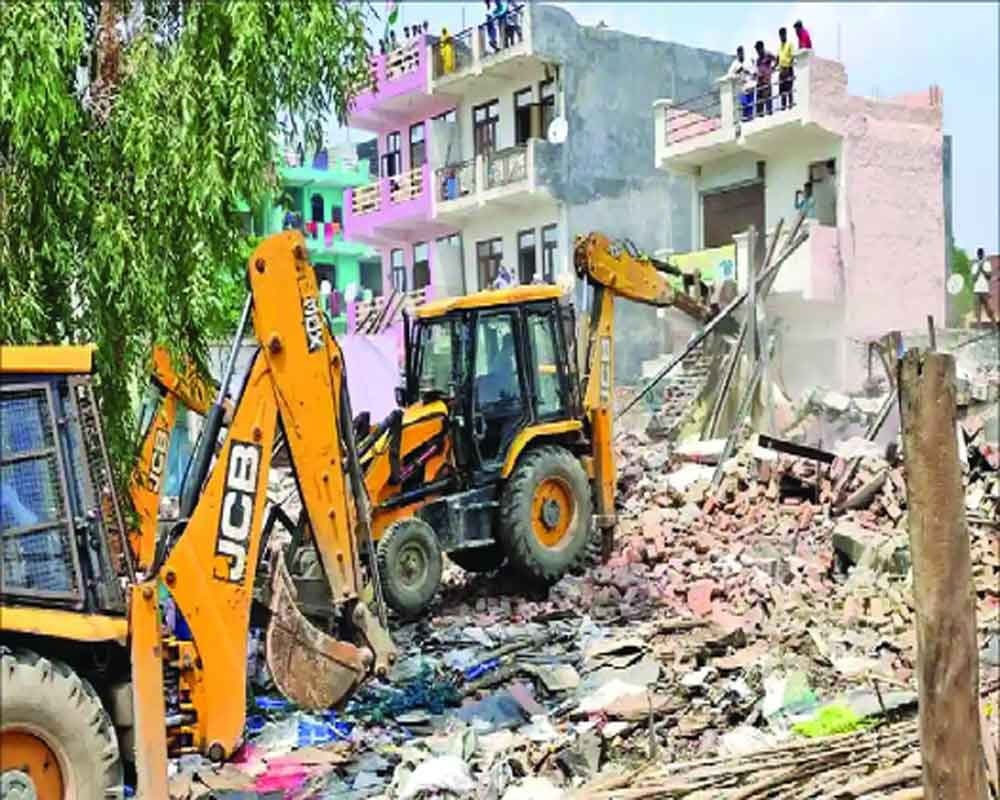
In a significant development in the Indian legal landscape, the Supreme Court has issued a temporary stay on the controversial practice of ‘bulldozer justice.’ This term has been coined to describe the widespread use of bulldozers to demolish properties, often in the context of punitive measures against alleged offenders, without due judicial process.

The apex court’s decision comes amid growing concerns over the erosion of legal norms and procedural fairness. Critics argue that such actions, which have become increasingly common in several states, undermine the principles of justice and human rights. They assert that demolitions carried out without adequate legal proceedings or due process amount to a form of extrajudicial punishment, potentially violating constitutional guarantees.
The practice of ‘bulldozer justice’ gained prominence in recent years, with several high-profile cases drawing national attention. Often, these demolitions are carried out as a form of retributive justice against individuals accused of various crimes, ranging from petty offenses to serious allegations. Proponents of the practice argue that it serves as a deterrent and a tool for swift action against unlawful activities. However, the lack of judicial oversight has sparked widespread criticism.
The Supreme Court’s intervention marks a pivotal moment in this ongoing debate. In its ruling, the court emphasized the importance of adhering to established legal procedures and respecting the rights of individuals accused of crimes. The court’s decision is seen as a reaffirmation of the fundamental principles of justice, emphasizing that punitive measures must be carried out within the framework of the law.
The stay granted by the Supreme Court comes after a series of petitions challenging the legality of ‘bulldozer justice.’ Petitioners argued that such actions often result in the destruction of property without proper investigation or trial, leading to disproportionate punishment. The court’s ruling underscores the need for a balance between maintaining public order and upholding legal safeguards.
Legal experts view the Supreme Court’s decision as a crucial step in reinforcing the rule of law and ensuring that justice is administered fairly. The ruling serves as a reminder that the judicial system must act as a check on executive actions and that no individual should be subjected to punishment without a fair trial.
As the legal community and human rights advocates await further developments, the Supreme Court’s pause on ‘bulldozer justice’ is likely to spark renewed discussions on judicial reforms and the need for a more equitable legal system. The case highlights the ongoing tension between the need for effective law enforcement and the imperative to protect individual rights.
In conclusion, the Supreme Court’s decision to pause ‘bulldozer justice’ is a significant development in India’s legal and human rights landscape. It underscores the importance of adhering to legal norms and ensuring that justice is delivered through established judicial processes. As the nation navigates these complex issues, the ruling serves as a vital reminder of the enduring principles of fairness and due process.


















Comments 4