


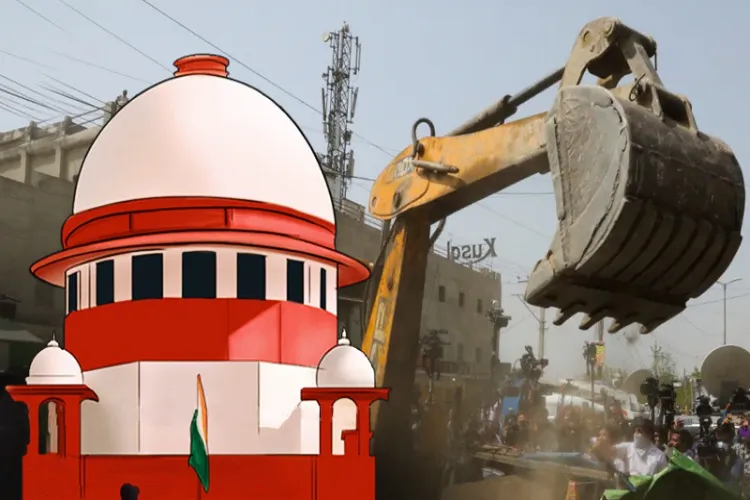
In a landmark ruling on October 1, 2024, the Supreme Court of India emphasized that the country’s anti-encroachment drives and bulldozer actions must be applied uniformly across all religious groups, reinforcing India’s secular ethos. The court, addressing petitions against the practice of bulldozing properties without due legal process, made it clear that public safety and the integrity of public infrastructure must take precedence over religious considerations. Any unauthorized structures, whether they are temples, mosques, or any other religious sites, obstructing public pathways or infrastructure, must be removed without bias.

This ruling comes amid widespread concerns over the use of bulldozer actions, a strategy that has gained attention in several states like Uttar Pradesh, Gujarat, and Madhya Pradesh, where authorities have demolished structures belonging to individuals accused of criminal activities. Critics have termed this trend “bulldozer justice,” accusing the government of employing these actions disproportionately against minority communities. However, the Supreme Court firmly rejected any such religious discrimination, asserting that its directions apply to all citizens, irrespective of their faith.
The bench, comprising Justice BR Gavai and Justice KV Viswanathan, addressed the petitioners’ concerns, emphasizing that demolitions cannot occur without following due process. The court had previously ruled that demolitions should not be carried out without prior judicial approval unless they involve clear violations of public infrastructure, such as encroachments on roads, railway tracks, or water bodies. The judges also stressed that even in cases of serious criminal accusations, such as terrorism or rape, the accused are entitled to proper legal procedures before their properties are demolished.
The court’s stance comes in response to allegations that the bulldozer actions disproportionately affect religious minorities. The Solicitor General representing several states clarified that accusations of crime cannot justify demolition without due legal notice. Municipal laws require proper advance notice before any demolition, and the court reiterated the need for transparency in such actions. The establishment of an online portal was suggested to ensure that the public can track demolition orders, enhancing accountability.
In its directive, the Supreme Court reaffirmed that India’s secular framework does not permit any religion to claim special privileges in matters of public safety and encroachment. The ruling sent a strong message that no religious structure, whether a temple, mosque, or gurudwara, can block public infrastructure or access. This, the court argued, would be a violation of the rights of citizens who rely on unimpeded access to roads and other essential infrastructure.
Additionally, the court sought to address concerns about the potential targeting of specific communities. The justices highlighted the importance of fairness in the execution of such policies, stating that the rule of law must apply evenly to all citizens, regardless of religious or community affiliations. They also pointed out the sheer scale of these actions, noting that an estimated 445,000 individuals could be affected by demolitions across various states, underscoring the need for clarity and adherence to legal protocols.
This ruling is seen as a significant step towards balancing the need for maintaining public safety and infrastructure with the constitutional rights of individuals. It sends a clear message to state authorities that while anti-encroachment drives are necessary, they must be conducted without discrimination and in accordance with the law. The court’s insistence on judicial oversight and proper legal procedures is a reminder that even in cases involving illegal constructions, the rights of the accused must be respected.
In conclusion, the Supreme Court’s ruling reinforces the importance of upholding secular values in India’s governance and legal system. It sets a precedent for how religious structures and encroachments should be handled, ensuring that no group is unfairly targeted, and all citizens are treated equally under the law. This judgment is likely to have far-reaching implications for future anti-encroachment drives and public safety measures across the country.

















Comments 1