


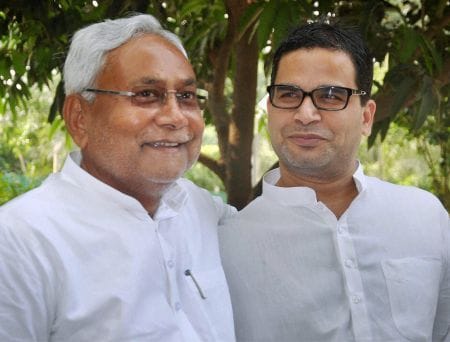
Political strategist-turned-activist Prashant Kishor launched a fierce critique of Bihar Chief Minister Nitish Kumar, accusing the state’s administration of being under the control of four retired bureaucrats. In a recent statement, Kishor claimed that these former officials have taken over crucial decision-making processes, leaving the CM in their grip. This accusation reflects Kishor’s long-standing dissatisfaction with Kumar’s leadership, which he believes has become disconnected from the concerns of ordinary Biharis.

Kishor, who once played a pivotal role in shaping the electoral success of Nitish Kumar, has since distanced himself from the JD(U) leader and is now a vocal critic. He has repeatedly accused Kumar of running a government that prioritizes bureaucratic control over democratic governance. Kishor’s latest comments highlight a deeper issue: he believes that the CM has lost touch with the people of Bihar and is more focused on clinging to power than addressing the state’s pressing challenges.
The Bureaucratic Grip on Bihar
Kishor’s allegation that four retired bureaucrats hold disproportionate sway over Bihar’s governance underscores his critique of Nitish Kumar’s leadership style. According to Kishor, these former officials are the real power behind the scenes, making crucial decisions that impact the lives of millions in the state. He claims that the Chief Minister is merely a figurehead, held hostage by these individuals, and that the bureaucrats are indifferent to the struggles of the common people.
This situation, according to Kishor, has led to an ineffective administration that is unable to address key issues like unemployment, infrastructure development, and public welfare. Kishor’s charge is not merely a personal attack but a critique of how governance in Bihar has allegedly been centralized around a small group of unelected officials, sidelining the elected representatives and, by extension, the people of the state.
Criticism of Policies: The Three S’s
Kishor’s criticism goes beyond the bureaucratic control. He has also raised concerns about several policies of the Nitish Kumar government, particularly the state’s prohibition law. Kishor claims that the liquor ban, introduced in 2016, is ineffective and has given rise to a thriving black market controlled by the liquor mafia. He argues that the policy has caused the state to lose approximately ₹20,000 crore annually while failing to curb alcohol consumption.
Additionally, Kishor has identified three critical issues—sarab (liquor), survey (land), and smart meter—that he believes will be the focal points of the 2025 Bihar assembly elections. He argues that these issues represent the failures of the Nitish Kumar government, and he is positioning his political movement, Jan Suraj, as an alternative that will address these problems head-on.
Kishor’s Political Ambitions
Kishor’s sharp critique of Nitish Kumar is part of his broader political agenda. He has been actively working on building a grassroots movement in Bihar through his Jan Suraj initiative, which aims to challenge the existing political order in the state. Kishor has vowed to dislodge the current JD(U)-RJD alliance in the 2025 assembly elections, predicting a decisive victory for his movement.
Kishor has promised that if his party comes to power, one of the first actions will be to repeal the liquor ban within an hour. His rationale is that the prohibition has failed to achieve its intended goals and is causing more harm than good. Kishor’s stand on this issue is significant, as the liquor ban was widely seen as a policy that appealed to women voters, a demographic that Nitish Kumar has relied on in past elections.
The Road Ahead for Nitish Kumar
Kishor’s prediction for Nitish Kumar’s political future is grim. He believes that the 2025 assembly elections will mark the end of Kumar’s long tenure as Bihar’s Chief Minister. Kishor has accused Kumar of clinging to power, comparing his hold on the CM’s chair to someone who has applied adhesive to it. He also criticized both Kumar and his ally, RJD chief Lalu Prasad Yadav, for their role in what he described as the “destruction of Bihar.”
While Kishor’s rhetoric is undoubtedly sharp, it remains to be seen how much traction his movement will gain in the run-up to the 2025 elections. Nitish Kumar has proven to be a resilient political figure, having held the Chief Minister’s post for over a decade and a half. However, Kishor’s criticisms tap into growing frustrations among some sections of the electorate, particularly with regards to governance and the state’s development trajectory.
Conclusion
Prashant Kishor’s attack on Nitish Kumar reflects a deepening political rift between the two former allies. Kishor’s claims that the state is being run by retired bureaucrats, combined with his critique of the prohibition policy and other governance issues, are part of his broader strategy to challenge the existing political order in Bihar. With the 2025 assembly elections on the horizon, Kishor’s Jan Suraj movement is positioning itself as a serious contender, aiming to offer an alternative to the JD(U)-RJD alliance that currently governs the state.
As Bihar moves closer to the elections, it remains to be seen whether Kishor’s critique will resonate with the electorate or if Nitish Kumar will once again prove his political mettle. What is clear, however, is that the battle for Bihar’s political future is heating up, and both sides are gearing up for a fiercely contested election.


















Comments 1