


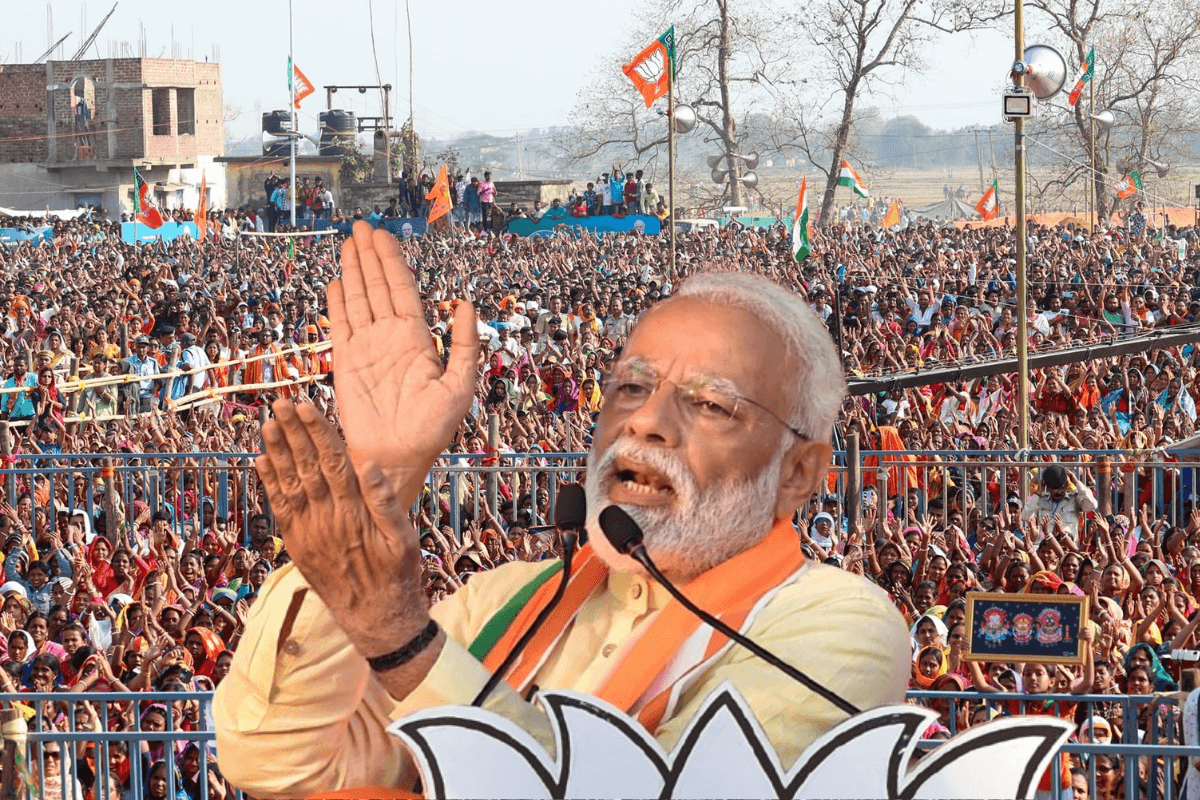
Prime Minister Narendra Modi’s recent visit to Haryana, ahead of the upcoming assembly elections, saw him delivering a series of sharp political jabs, especially targeting the Congress party. Speaking at a rally in Hisar, Modi revived the famous song lyric “Kya Hua Tera Vada?” to mock Congress for failing to deliver on promises made to Himachal Pradesh voters during the elections. His criticism extended to highlighting the unfulfilled commitments in Congress-ruled states, calling the party deceptive and unreliable in governance.

Modi didn’t stop at accusing Congress of breaking promises; he emphasized the widespread dissatisfaction in Himachal, where employees are protesting over unaddressed issues despite Congress’ pre-election assurances. The “Kya Hua Tera Vada?” remark resonated with the crowd, turning into a symbol of Modi’s broader narrative of questioning Congress’ credibility across India.
The Prime Minister also took the opportunity to rally BJP workers and Haryana voters by showcasing the differences in governance between BJP and Congress-led states. He praised the BJP for delivering development and stability, contrasting it with what he described as Congress’ pattern of corruption and incompetence. Modi was particularly critical of Congress’ leadership, claiming that the party’s internal divisions reflected their inability to lead a unified front.
At the core of his speech was a focus on party workers in Haryana. He urged them to continue supporting BJP’s development agenda, citing the state’s impressive progress under the leadership of the Khattar government. Modi credited the Haryana administration for its initiatives in infrastructure, employment, and women’s empowerment, positioning it as a model of governance that could be replicated nationwide if BJP remained in power.
Modi’s speech also included a strategic dig at Congress’ internal disunity. He questioned the coherence of Congress’ leadership in Haryana, suggesting that the party’s fragmented leadership would prevent it from mounting a serious challenge to the BJP in the upcoming elections. His comment, “No unity among its leaders,” referred to Congress’ persistent internal factionalism, which, according to Modi, would result in voters losing faith in the party’s ability to govern effectively.
This election rally was not just a defense of BJP’s tenure in Haryana but also an opportunity for Modi to lay the groundwork for 2024’s general elections. Modi portrayed the upcoming assembly election as a stepping stone toward retaining power at the national level, urging voters in Haryana to ensure BJP’s victory by maintaining their trust in the party’s developmental policies.
His appeal to the masses was laced with a plea for continuity, assuring that re-electing BJP in Haryana would result in a seamless extension of the party’s national agenda. Modi also drew attention to Congress’ history of dynastic politics, accusing the party of prioritizing family interests over the welfare of the nation.
Throughout his speech, Modi employed a mix of emotional appeals and data-driven arguments to underline BJP’s achievements and attack Congress’ track record. His rallying cry was designed to energize the party’s base and convey the message that the BJP was the only party capable of ensuring Haryana’s continued progress.
As the assembly elections draw near, Modi’s speech set the tone for what promises to be a heated contest between BJP and Congress, with Modi making it clear that his party’s focus would remain on development, governance, and stability. Meanwhile, his remarks also reflect BJP’s determination to challenge Congress’ credibility not only in Haryana but across other states.
In sum, Modi’s speech was a strategic blend of criticism and advocacy, combining his vision for Haryana’s future with sharp attacks on Congress.














Comments 4