



In a sharp rebuttal to Congress leader Rahul Gandhi’s recent comments, Prime Minister Narendra Modi has accused Gandhi of harboring a “Naxal mindset” and importing divisive ideologies into Indian politics. This clash of rhetoric has added a new dimension to the ongoing political discourse in the country, highlighting the increasing tension between the ruling Bharatiya Janata Party (BJP) and the Congress party.

Context of the Controversy
The controversy erupted following Rahul Gandhi’s remarks that seemingly disparaged Prime Minister Modi by referring to him as a ‘devta’ (deity) in a derogatory context. Gandhi’s comments were made during a speech aimed at criticizing the Modi government’s policies and alleged authoritarian tendencies. He accused the Prime Minister of promoting a personality cult that places him above democratic accountability and scrutiny.
In response, Prime Minister Modi has vehemently criticized Gandhi’s remarks, characterizing them as part of a broader pattern of divisive and destructive rhetoric. Modi’s retort comes at a time when political tensions are high, with both parties engaged in intense electoral battles and public discourse.
Modi’s Strong Rebuttal
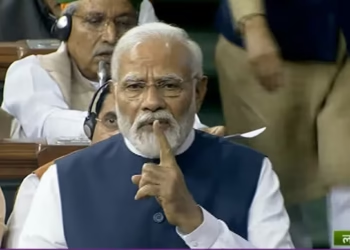
During a recent public address, Prime Minister Modi launched a scathing attack on Rahul Gandhi, accusing him of importing a “Naxal mindset” into mainstream politics. He asserted that Gandhi’s comments were emblematic of a larger ideological shift that seeks to undermine India’s democratic institutions and foster division within the society.
“Naxal mindset,” Modi said, “is a term used to describe those who reject democratic norms and advocate for radical, disruptive methods. Gandhi’s remarks reflect this dangerous ideology that seeks to delegitimize the democratic process and create unrest.”
The Prime Minister also argued that Gandhi’s rhetoric was an attempt to distract from the Congress party’s failures and lack of constructive solutions. Modi suggested that such comments only serve to exacerbate political polarization and undermine the country’s progress.
Political Reactions and Implications
The Prime Minister’s comments have elicited a range of reactions from various political quarters. Supporters of the BJP have praised Modi for standing firm against what they perceive as anti-national sentiments. They argue that Gandhi’s remarks are indicative of the Congress party’s struggle to adapt to contemporary political realities and its tendency to rely on outdated and disruptive tactics.
On the other hand, Congress leaders have denounced Modi’s attack as an attempt to deflect attention from real issues facing the nation. They argue that Modi’s response is an overreach intended to stifle dissent and criticism. Congress spokespersons have accused the Prime Minister of engaging in personal attacks rather than addressing substantive policy issues.
Public and Media Reaction
The media and public reaction to this political skirmish has been robust. Analysts and commentators have noted that the exchange reflects a broader trend of increasing political acrimony in India. The use of terms like “Naxal mindset” in mainstream political discourse is seen as indicative of the polarized nature of current political debates.
Public opinion is divided, with some viewing Modi’s response as a necessary defense against what they see as harmful rhetoric, while others criticize it as a diversion from pressing issues such as economic challenges and social inequality.
Looking Forward
As the political landscape continues to evolve, this clash between PM Modi and Rahul Gandhi is likely to shape the discourse leading up to upcoming elections. The rhetoric from both sides highlights the deep-seated ideological divides within Indian politics and underscores the challenges of navigating a democratic society in an era of heightened polarization.
In the coming days, it will be crucial to monitor how both leaders adjust their strategies in response to the ongoing exchange. The ability to address the concerns of the electorate while maintaining a respectful and constructive discourse will be pivotal in shaping the future political narrative.
Conclusion
The confrontation between Prime Minister Narendra Modi and Rahul Gandhi over the ‘devta’ remark represents a significant moment in Indian politics. Modi’s accusation of a “Naxal mindset” against Gandhi is a powerful statement that underscores the intensity of political rivalries and the broader ideological battles playing out in the country. As this controversy unfolds, it will be essential to observe how it impacts public sentiment and the broader political climate in India.














Comments 4