


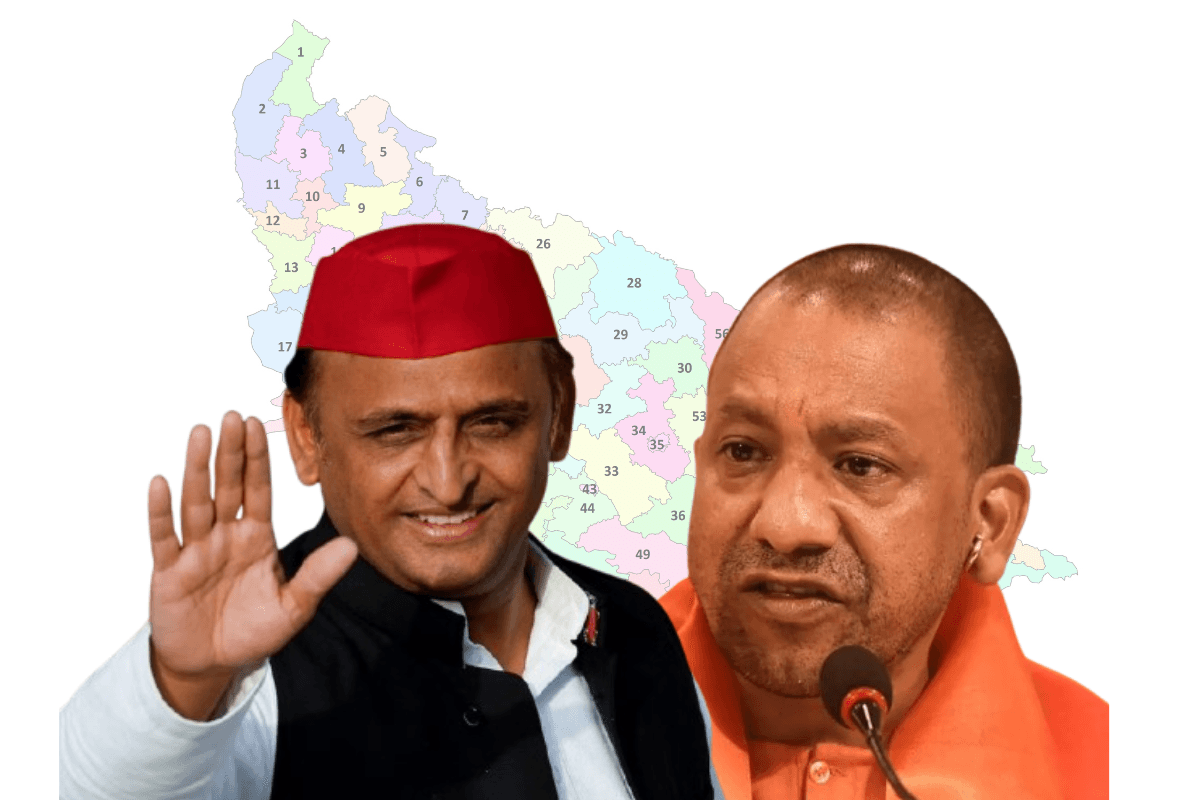
In the politically charged environment of Uttar Pradesh, two slogans—Samajwadi Party’s (SP) “Judenge Toh Jeetenge” (Unite to Win) and BJP’s “Batenge Toh Katenge” (Divided We Perish)—have come to embody the contrasting visions of unity and division in Indian politics. As the 2024 elections approach, these slogans have sparked conversations around social justice, communal harmony, and caste alliances, each aiming to rally voters under distinct ideological umbrellas. The slogans underscore not only the distinct messaging of the Samajwadi Party and the BJP but also larger social issues of representation, polarization, and the role of unity in development.

“Judenge Toh Jeetenge”: SP’s Call for Unity and Inclusivity
The Samajwadi Party (SP), under Akhilesh Yadav’s leadership, is focusing on an inclusive message with “Judenge Toh Jeetenge.” Rooted in SP’s traditional base of Yadavs, Muslims, and other backward castes (OBCs), the slogan underscores an effort to unify historically marginalized communities against a dominant narrative that it claims ignores their voices. By advocating for unity, Yadav seeks to build a coalition among castes and communities that have felt politically sidelined under the BJP’s governance. This strategy, often referred to as the “M-Y” (Muslim-Yadav) alliance, aims to draw from the history of SP’s influence in UP, where such coalitions have enabled it to stand strong against larger national parties.
This unity-based approach resonates particularly in rural and semi-urban areas where caste-based inequalities remain pronounced. SP’s strategy is to mobilize these groups through social justice initiatives, economic reforms, and inclusive policies, promising voters a government that addresses their unique challenges. The idea is that by “uniting,” these communities can form a powerful counterweight against the BJP, which has a stronghold in UP with a well-organized vote bank of upper castes, certain OBC sections, and non-Yadav backward castes.
SP’s strategy is particularly relevant within the larger alliance of the INDIA bloc, a coalition of opposition parties united against the BJP. Yadav’s leadership role within this bloc strengthens his position as a national leader and reinforces his slogan. The INDIA bloc, comprised of 28 parties, echoes the theme of “Judenge Toh Jeetenge” in its mission to unify underrepresented voices to counterbalance BJP’s policies. This alignment is a strategic attempt to consolidate anti-BJP votes, a challenge historically hindered by the fractured opposition.
“Batenge Toh Katenge”: BJP’s Stand Against Division
On the other hand, BJP leader Yogi Adityanath’s slogan, “Batenge Toh Katenge,” underscores his emphasis on communal unity within the Hindu community. Yogi Adityanath, the Chief Minister of Uttar Pradesh, has used the slogan to warn against internal divisions, specifically within the Hindu vote bank. This slogan was most recently displayed in posters in Maharashtra ahead of the assembly polls, indicating that the BJP sees this slogan as resonant with a national audience as well as in UP.
The message is twofold: Adityanath wants to emphasize that a united Hindu community is essential for preserving cultural identity, safety, and prosperity. The slogan calls upon Hindus to avoid internal divisions—whether regional, linguistic, or caste-based—and to consolidate support for BJP, particularly in the face of perceived threats from opposition alliances like INDIA. Adityanath often refers to neighboring Bangladesh as a cautionary example, emphasizing that disunity could lead to adverse outcomes, similar to the political upheaval seen there recently.
By urging the Hindu community to “stay united” under the BJP’s umbrella, Adityanath has tied the party’s policies to themes of security, economic prosperity, and development. He invokes national pride and frames unity as an essential component for achieving economic and social progress. This narrative aims to retain BJP’s substantial support base in UP, where Hindu nationalist rhetoric has proven highly effective in securing votes.
Contrasting Ideologies and Their Impact on Voter Base
The slogans represent divergent approaches in UP’s highly charged electoral atmosphere. SP’s “Judenge Toh Jeetenge” aims to highlight the importance of inclusivity and social equity, positioning Akhilesh Yadav as a unifying figure who advocates for the underrepresented. This message resonates with voters who feel marginalized or ignored by the current state and central government policies. SP’s inclusivity rhetoric appeals to OBCs, Dalits, and other marginalized groups, as it promises policies tailored to their economic and social advancement.
On the contrary, BJP’s “Batenge Toh Katenge” slogan plays on the fear of division weakening the Hindu community and hampering India’s progress. This rhetoric is particularly potent among voters who prioritize cultural unity and are cautious about multi-party coalitions with diverse, sometimes conflicting, agendas. By positioning itself as the party that will protect Hindu unity and development, the BJP seeks to reinforce loyalty among its base and sway undecided voters who prioritize security and stability over coalition politics.
The Larger Implications of These Political Narratives
The slogans tap into deep-rooted issues within UP’s social and political fabric, reflecting both the aspirations and anxieties of its electorate. On one hand, SP’s slogan appeals to the hopes of those seeking a shift towards a more inclusive governance model. On the other hand, BJP’s slogan appeals to the fear of fragmentation, using cultural identity as a unifying factor. Both slogans thus serve as focal points for each party’s campaign strategies, aiming to consolidate their respective voter bases by addressing their concerns.
In a broader sense, these contrasting messages highlight the challenge facing Indian democracy: balancing cultural unity with social justice and inclusivity. As UP heads into elections, the outcomes will likely influence national politics, particularly the degree to which coalition politics can counterbalance BJP’s centralized leadership. Both slogans hint at a larger political struggle that extends beyond UP, as India navigates its path toward development and social cohesion in a complex, multi-cultural society.
Conclusion: A Political Battleground for India’s Future
In Uttar Pradesh, a state that holds significant sway over national politics, “Judenge Toh Jeetenge” and “Batenge Toh Katenge” have become battle cries representing two divergent visions for India’s future. As SP rallies for unity across communities and BJP campaigns for cultural solidarity, voters are faced with a choice between coalition-driven inclusivity and singularly focused cultural unity. The significance of these slogans lies not just in their immediate political impact, but also in their broader reflection of India’s ongoing journey toward an equitable, unified society.
With both slogans likely to gain further prominence as election campaigns intensify, the state of Uttar Pradesh stands as a microcosm for larger national debates about identity, unity, and development. Whether voters lean towards the inclusive unity promised by SP or the cultural cohesion emphasized by BJP will shape not only UP’s political landscape but also the future course of Indian politics as a whole
READ MORE : News18 / The New Indian Express.


















Comments 1