


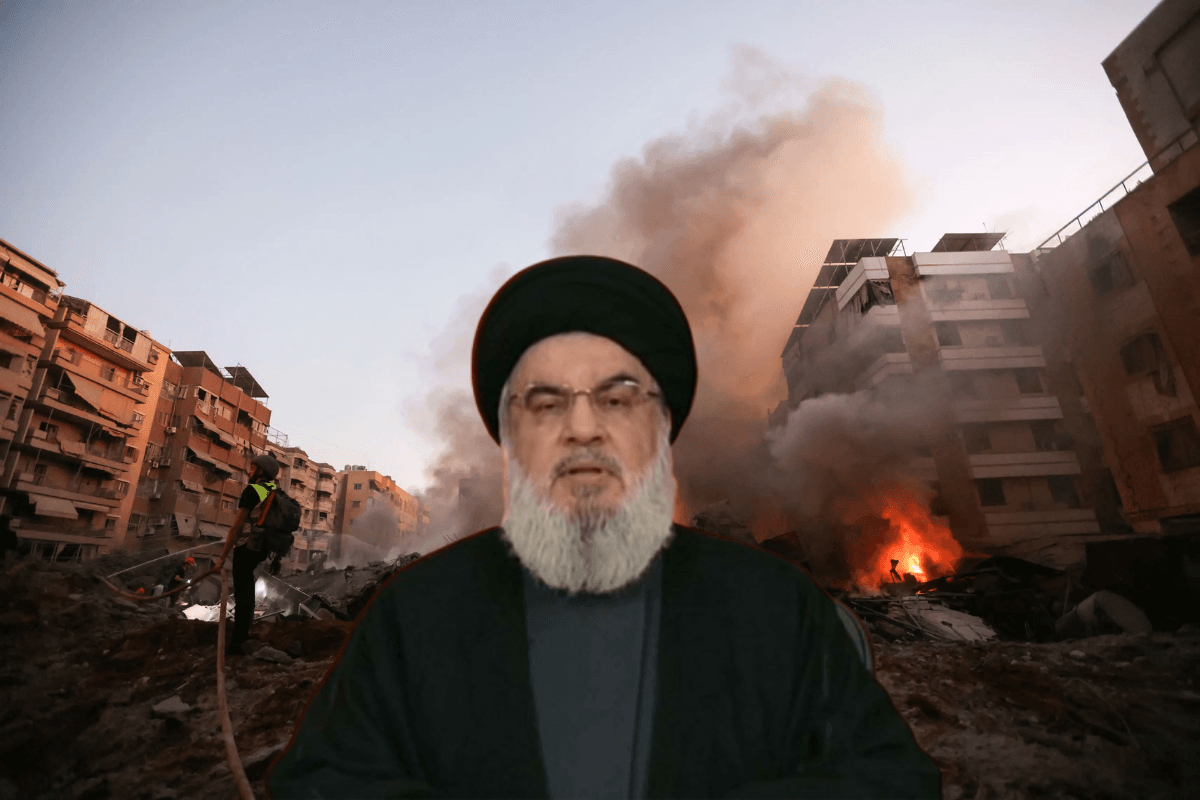
In a dramatic escalation of hostilities between Israel and Hezbollah, the Israeli army has claimed to have killed Hezbollah’s leader, Hassan Nasrallah, in an airstrike targeting the southern suburbs of Beirut. The strike reportedly hit Hezbollah’s key command center in Beirut’s Dahiyeh area, often associated with Nasrallah. While Israel insists the Hezbollah chief was killed, conflicting reports from Hezbollah and other sources like Iran suggest that Nasrallah may still be alive.

Background: Rising Tensions and Escalations
The strike comes amid a backdrop of growing tensions between Hezbollah and Israel, rooted in the wider geopolitical landscape of the Middle East. Hezbollah, a Shiite militant group backed by Iran, has been a significant adversary of Israel for decades, with several flare-ups between the two sides since the 2006 Israel-Hezbollah war. In recent weeks, the situation has become more volatile, with Hezbollah launching rockets into northern Israel and Israel responding with airstrikes deep into Lebanese territory.
This latest round of hostilities began following the October 2023 attack by Hamas on Israel, which reignited longstanding Israeli concerns over security threats from Lebanon. Hezbollah ramped up its rocket fire into Israel, prompting strong retaliatory measures. The strike that allegedly killed Nasrallah was part of a broader Israeli campaign targeting Hezbollah infrastructure across Lebanon, which has been particularly intense in the southern suburbs of Beirut.
The Airstrike: Targeting Hezbollah Leadership
Israel’s airstrike reportedly targeted a complex in Dahiyeh, a densely populated neighborhood in Beirut, known to house key Hezbollah leadership figures. The area, a Hezbollah stronghold, has been heavily bombed in the past but remains central to the group’s operations. Israeli military officials stated that the primary objective of this mission was to decimate Hezbollah’s command structure, which includes Nasrallah.
A senior Israeli official told reporters that while Hezbollah’s missile unit commander Muhammad Ali Ismail and his deputy Hossein Ahmed Ismail were confirmed killed, the fate of Nasrallah was initially uncertain. However, Israeli intelligence later suggested that Nasrallah had been eliminated in the raid. The official explained that Hezbollah typically withholds information about casualties, especially when high-ranking officials are involved, which could explain why Hezbollah has not yet confirmed Nasrallah’s death(
).
Hezbollah and Regional Reactions
Following the airstrike, Hezbollah’s media outlets initially claimed that Nasrallah was alive and had not been in the area during the time of the attack. Iran’s state-controlled Tasnim news agency also reported that Nasrallah was safe, while Lebanese sources close to Hezbollah stated that he had been moved to an undisclosed location prior to the strike. Iranian officials have expressed outrage at the attack, with Tehran describing it as an escalation that crossed “red lines.” Iran, which provides significant financial and military support to Hezbollah, has vowed to retaliate against what it views as Israel’s aggression.
Hezbollah, however, has yet to produce any visual or public statement from Nasrallah, fueling speculation about his fate. The organization has a history of maintaining secrecy around its leadership, particularly during times of intense conflict. Should Nasrallah’s death be confirmed, it would be the first time that a Hezbollah leader of his stature has been killed since the group’s formation in the early 1980s.
Strategic Implications: Hezbollah Without Nasrallah?
If Hassan Nasrallah has indeed been killed, this marks a pivotal moment in the long-standing conflict between Hezbollah and Israel. Nasrallah has been the face of Hezbollah for over three decades, guiding the organization through numerous military conflicts, political shifts, and regional upheavals. His leadership was integral to transforming Hezbollah from a local resistance movement into a powerful political and military entity in Lebanon, with considerable influence across the Middle East.
Nasrallah’s elimination would leave a significant void in Hezbollah’s leadership structure, creating uncertainty over the group’s future direction. While Hezbollah has a well-established chain of command, Nasrallah’s charisma, strategic acumen, and ability to maintain unity within the group were unparalleled. His absence could lead to internal power struggles within Hezbollah, potentially weakening the organization or altering its stance toward Israel.
Israel’s Justification and International Response
Israeli Prime Minister Benjamin Netanyahu has defended the military campaign, arguing that as long as Hezbollah remains committed to war, Israel has no choice but to defend itself aggressively. Netanyahu, who cut short his trip to New York to return to Israel amid escalating violence, stated, “Israel has every right to remove this threat and ensure the safety of its citizens.” His comments came just days after addressing the United Nations, where he faced walkouts from multiple delegations who opposed his government’s military actions.
While Israel insists that its airstrikes are aimed at military targets, Hezbollah and Lebanese authorities claim that many of the strikes have hit civilian areas, resulting in significant casualties. Over the past week alone, Lebanese health officials have reported hundreds of deaths and injuries as Israeli strikes have intensified across the country. The international community has expressed growing concerns, with calls for a ceasefire coming from countries like France and the United States. U.S. Secretary of State Antony Blinken emphasized diplomacy as the preferred path forward, urging both sides to de-escalate the conflict.
The Larger Geopolitical Picture
The potential killing of Nasrallah comes at a time when the region is already deeply destabilized by the Israeli-Palestinian conflict. Hezbollah has long been viewed as a proxy for Iran in its regional power struggle with Israel, and Nasrallah’s death could inflame tensions between Israel and Iran. Tehran’s influence in Lebanon, Syria, and Iraq is well-established, and any attempt by Israel to weaken Hezbollah will likely face a strong reaction from Iran.
The risk of a broader regional war cannot be discounted, especially given the existing hostilities between Israel and Iranian-backed militias across the Middle East. Both the U.S. and the United Nations have voiced concerns that an escalation of this conflict could spiral out of control, pulling in neighboring countries and exacerbating the already volatile situation in Gaza.
Conclusion: Uncertainty Ahead
The fate of Hassan Nasrallah remains shrouded in uncertainty, but the implications of his potential death are far-reaching. Should his elimination be confirmed, it would mark a historic moment in the Israeli-Hezbollah conflict, potentially reshaping the dynamics of power in Lebanon and across the Middle East. As both sides prepare for what could be a prolonged confrontation, the region faces an uncertain future, with the risk of broader conflict looming large.
For now, the world watches closely to see how Hezbollah and Iran will respond to this latest blow, and whether Israel’s claims about Nasrallah’s death will be verified or refuted in the coming days
More Info : (RNZ)(India Today).

















Comments 5