


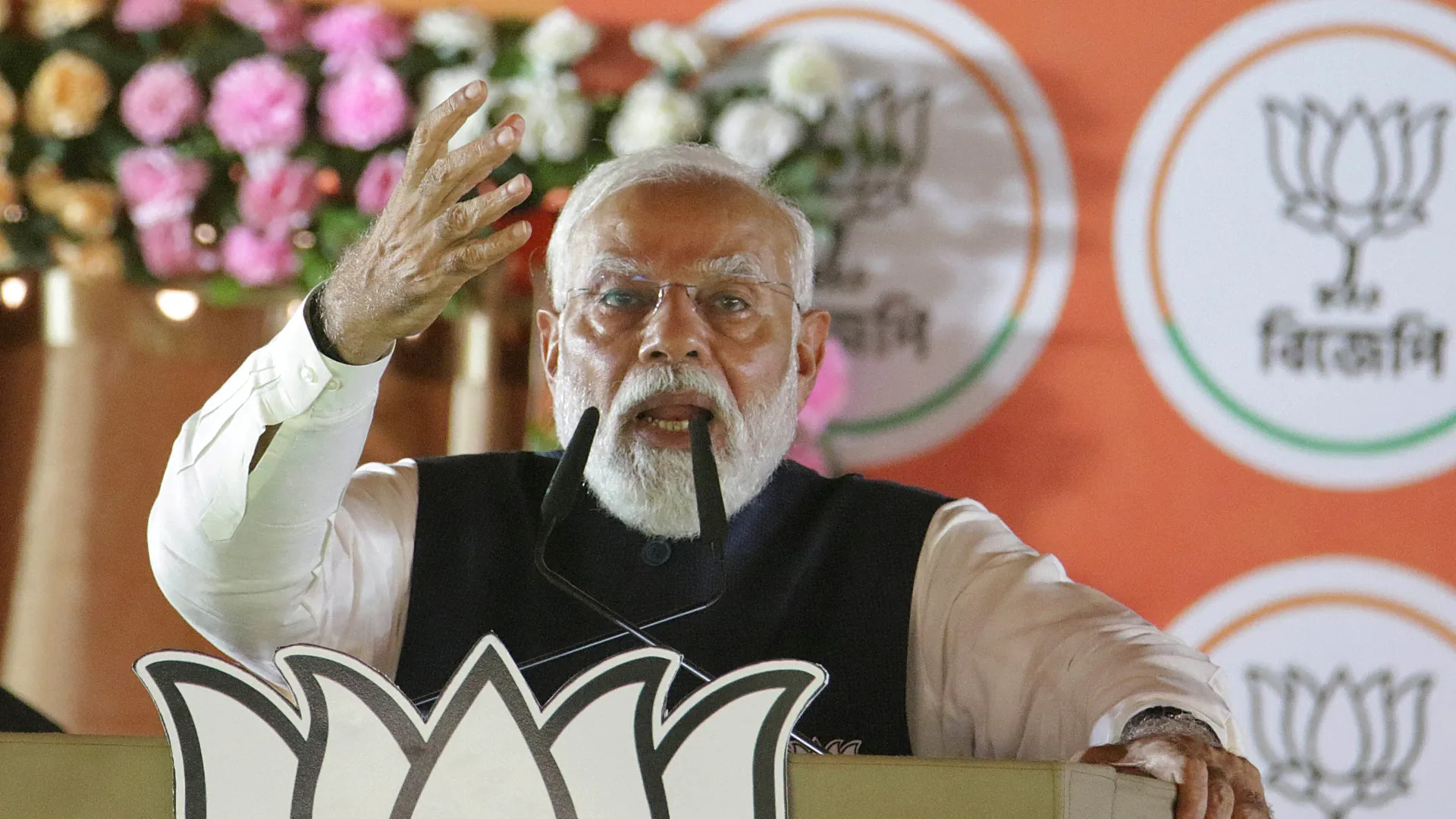
Prime Minister Narendra Modi recently delivered a scathing speech, accusing the Congress party of playing divisive politics by focusing on caste-based divisions within the Hindu community while remaining silent on caste-related issues within the Muslim community. This speech, which has sparked debates in Indian political circles, raises important questions about the role of religion and caste in Indian politics, the nature of political strategies employed by both the BJP and Congress, and why religious and caste-based identities continue to dominate political discourse rather than issues of progress and prosperity.

Modi’s Attack on Congress: “Dividing Hindus by Caste”
In his address, Prime Minister Modi accused Congress of deliberately trying to divide Hindus based on caste lines. According to him, this strategy is aimed at weakening the unity of Hindus by promoting internal divisions, which in turn could benefit Congress electorally. However, he pointed out that Congress conveniently avoids talking about caste distinctions within the Muslim community, portraying this as a selective form of identity politics. Modi claimed that Congress’s focus on dividing Hindus by caste is an old political trick aimed at fragmenting the majority vote while securing support from minority groups.
Modi’s speech was delivered in a political atmosphere charged with electoral anticipation. As assembly elections and the national elections of 2024 draw closer, such speeches become a crucial tool for mobilizing the voter base. Modi’s rhetoric struck a chord with his supporters, who believe that the BJP’s focus on Hindutva, national unity, and development stands in contrast to Congress’s alleged divisive tactics.
BJP’s Strategy: Religion and Nationalism
The Bharatiya Janata Party (BJP), under Modi’s leadership, has centered much of its political strategy on a combination of Hindu nationalism and development-oriented policies. The party’s narrative often paints itself as a protector of Hindu interests and a proponent of national unity, while accusing opposition parties like Congress of pandering to minority communities and engaging in divisive identity politics.
Critics of the BJP argue that the party’s focus on Hindutva, or Hindu nationalism, also represents a form of divisive politics, as it creates a dichotomy between the Hindu majority and other religious minorities, particularly Muslims. They argue that by positioning itself as the defender of Hindu interests, the BJP may inadvertently alienate non-Hindu communities, leading to increased polarization.
However, the BJP and its supporters counter this argument by emphasizing the party’s commitment to “Sabka Saath, Sabka Vikas, Sabka Vishwas” (Collective Effort, Inclusive Growth, and Everyone’s Trust). According to the BJP, its policies are aimed at benefiting all Indians, regardless of their religious or caste affiliations. From schemes like the Pradhan Mantri Awas Yojana (PMAY) to the Ayushman Bharat healthcare initiative, the party claims to focus on economic growth, poverty alleviation, and infrastructure development as unifying factors.
Congress’s Response: Secularism and Social Justice
On the other side of the political spectrum, Congress has traditionally branded itself as a secular party, committed to protecting the interests of all religious and social groups. Congress’s emphasis on caste-based reservations, affirmative action, and social justice initiatives has been a cornerstone of its political strategy. The party sees itself as a protector of marginalized communities, including Scheduled Castes (SCs), Scheduled Tribes (STs), Other Backward Classes (OBCs), and religious minorities.
In response to Modi’s accusations, Congress leaders have often pointed to the BJP’s alleged attempts to marginalize Muslim communities and the growing instances of communal violence and intolerance under its rule. Congress argues that the BJP’s brand of politics prioritizes religion over the secular fabric of the nation, which has been carefully nurtured since India’s independence.
Congress leaders have also highlighted the need to address caste-based inequalities within Hindu society through reservation policies and other affirmative action measures. However, the BJP views these policies as a form of appeasement and divisive politics, which pits one group against another.
Global Perspectives on India’s Religious and Caste-Based Politics
India’s unique blend of religious and caste-based politics has often drawn the attention of political analysts and media outlets worldwide. From a global perspective, India is seen as a thriving democracy, yet it faces challenges in balancing religious and caste identities with the aspirations for modernization and development.
International observers note that religious identity plays a significant role in shaping India’s political landscape. However, they also point out that India’s developmental achievements, such as its growing economy and advancements in technology, often take a back seat in electoral politics, which remain dominated by religious and caste considerations.
Countries with significant Indian diaspora populations, like the United States, the UK, and Canada, often express concern about the potential for increased religious and caste polarization in India. Media reports from these countries sometimes criticize the increasing communal tensions and the impact this has on India’s social cohesion. On the other hand, supporters of Modi’s government in the global arena praise his economic reforms and his efforts to present India as a rising global power.
Is Congress or BJP Playing the Caste and Religion Game?
One of the central questions arising from Modi’s speech is whether Congress or the BJP is more guilty of playing divisive politics based on caste and religion. The truth is that both parties have, at different times, employed identity-based politics to secure electoral gains.
Congress, through its emphasis on secularism and social justice, has historically garnered support from religious minorities and lower-caste communities. However, critics argue that this has sometimes led to a form of “vote-bank politics,” where certain groups are favored over others. Congress has also been accused of overlooking caste issues within the Muslim community, which Modi pointed out in his speech.
On the other hand, the BJP has been accused of fostering Hindu nationalism, which critics argue has contributed to increased polarization between religious communities. The party’s focus on Hindutva has at times been interpreted as prioritizing the interests of the Hindu majority, leading to allegations that the BJP is alienating Muslims and other minorities.
Why Do People Still Run for Religion in India Instead of Progress?
One of the most perplexing aspects of Indian politics is the persistent focus on religious and caste identities rather than issues of economic progress, development, and prosperity. Despite India’s tremendous achievements in fields like technology, science, and infrastructure, religious and caste-based politics continue to dominate elections.
Several factors contribute to this phenomenon:
- Historical Legacy: India’s history of colonization, partition, and communal tensions has left deep scars. Political leaders have, over time, tapped into these historical grievances to mobilize support. Caste divisions, in particular, have been deeply ingrained in Indian society for centuries, and while progress has been made, caste-based discrimination still affects many people’s lives.
- Vote-Bank Politics: Both national and regional parties have historically targeted specific religious or caste groups to secure votes. The large diversity of India’s population means that no single party can win an election without building coalitions of different social groups. This often leads to parties adopting identity-based strategies.
- Social and Economic Inequality: Economic disparities and social inequalities often make it easier for political parties to exploit caste and religious identities. For many, caste and religion provide a sense of identity and belonging in a world where they feel marginalized or left out of India’s growth story. Political parties often promise benefits, reservations, and protection to these groups to secure their loyalty.
- Media and Public Discourse: The media often plays a role in amplifying religious and caste-related issues, particularly during elections. Controversies surrounding religious symbols, temple constructions, or caste-based reservations frequently dominate news cycles, leaving less room for discussions on economic development, education, or healthcare.
Conclusion: The Future of Indian Politics
Prime Minister Modi’s speech accusing Congress of dividing Hindus by caste and being silent on Muslim caste distinctions is a reflection of the larger battle for India’s political future. Both BJP and Congress have their own narratives—one focused on Hindutva and development, the other on secularism and social justice. Yet, at the heart of Indian politics remains a deep-rooted focus on caste and religion, which continues to overshadow debates about progress and prosperity.
The question of why Indians still prioritize religious and caste-based identities in politics, despite the country’s incredible potential for economic growth and modernization, is complex. It is a product of historical, social, and political factors that continue to shape the lives and aspirations of millions. While political parties may seek to exploit these identities for electoral gains, the real challenge for India’s future will be how to transcend these divisions and create a political discourse that prioritizes development, equality, and the well-being of all its citizens.














Comments 2