

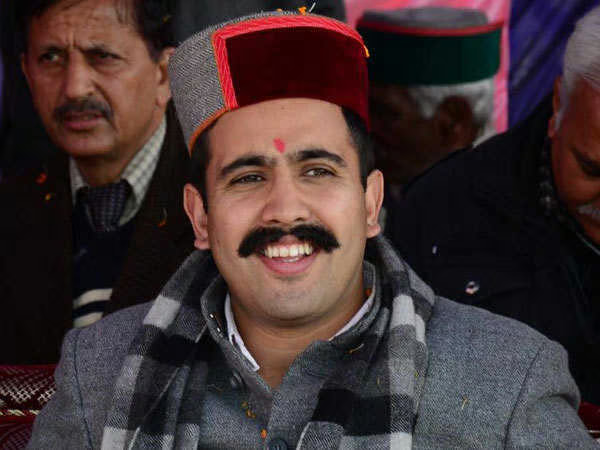
A controversy has arisen in Himachal Pradesh over a recent statement regarding the display of nameplates by eatery owners, sparking significant backlash. The issue originated when Himachal Pradesh’s Minister for Public Works and Urban Development, Vikramaditya Singh, proposed a policy that would require food vendors, particularly those running street stalls, to display their identification at their businesses. Singh stated that this initiative was inspired by a similar move in Uttar Pradesh, aimed at addressing concerns over the growing presence of migrants in the state.

However, the suggestion was quickly met with strong opposition from various quarters, including members of the Congress party itself, civil society groups, and local citizens. Critics argued that such a policy could foster communal tensions, potentially targeting certain groups of people based on their identity, and creating unnecessary divisions. The idea of mandatory nameplates, many feared, could lead to increased surveillance and discrimination against vendors, many of whom are from migrant communities.
In response to the backlash, the Himachal Pradesh government, led by Chief Minister Sukhvinder Singh Sukhu, distanced itself from Vikramaditya Singh’s remarks. Sukhu clarified that no official decision had been made to implement such a policy. The government emphasized that their primary aim was to regulate street vending in an orderly manner, without enforcing communal or divisive policies. Singh’s statement, which had drawn significant media attention, was reportedly discussed with the Congress high command, which expressed concern over the potential communal overtones of the proposal.
AICC in-charge for Himachal Pradesh, Rajiv Shukla, addressed the issue publicly, reaffirming that the government’s focus was on ensuring proper regulation and designated spaces for street vendors. According to Shukla, while there may be a requirement for vendors to present identification like Aadhaar cards for regulatory purposes, there was no mandate for public nameplates. He stressed that this was not an adoption of the Yogi Adityanath model from Uttar Pradesh, where such policies have been linked to communal narratives, and that the Himachal government’s actions were not intended to stir communal tensions.
This clarification has helped diffuse some of the tension, but the issue has underscored the sensitivity surrounding communal matters in the region, particularly with policies that could disproportionately affect migrant populations. Singh’s initial comments, intended to address local concerns about the growing number of migrants, have inadvertently touched on a broader, more delicate issue of communal harmony and the treatment of minorities.
The controversy also brings into focus the growing challenges that state governments face when attempting to regulate the informal sector, particularly street vendors, in ways that balance economic growth, local concerns, and social harmony. In Himachal Pradesh, a state with a significant tourism industry, street vendors play a critical role in providing affordable food options. Regulating this sector without alienating migrant communities or creating communal divisions is a tricky balancing act that the government is now navigating.
As the Himachal Pradesh government moves forward, it remains to be seen how they will implement policies that both address concerns about public safety and local business regulation while avoiding any steps that could be perceived as discriminatory. The government’s prompt response to clarify the situation has been welcomed by many, but ongoing vigilance will be necessary to ensure that future policies are implemented in a fair and inclusive manner(Hindustan Times)