

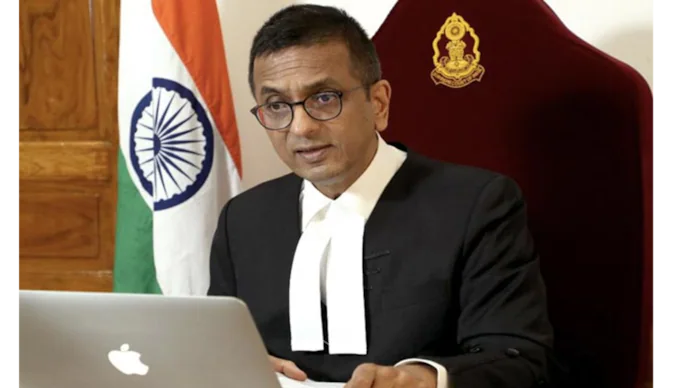
The Supreme Court of India recently addressed a sensitive issue involving a Karnataka High Court judge who referred to a Muslim-dominated area in Bengaluru as “Pakistan.” Chief Justice of India, D.Y. Chandrachud, leading a five-judge bench, expressed disapproval of the remarks, stating that no part of India can be referred to as “Pakistan.” The bench emphasized that such comments undermine the territorial integrity of the country and can spark controversy, especially in a country as diverse as India.

The case, which garnered significant attention on social media, was taken up suo motu (on its own accord) by the Supreme Court after videos of the judge’s comments surfaced online. One of the videos showed the judge making a gender-insensitive remark, while in another, he made the controversial “Pakistan” reference. These incidents triggered demands for accountability and led to the Supreme Court’s intervention.
During the hearing, the judge apologized for his comments in open court, and the Supreme Court, after careful consideration, decided to close the proceedings. The court highlighted the importance of judicial responsibility, particularly in today’s age of social media, where casual comments can spread rapidly and have far-reaching consequences. The court urged judges to be more mindful of their language, as it can reveal biases or prejudices that could harm the image of the judiciary.
The court also tackled the larger issue of transparency in the judicial process, advocating for more openness through live-streaming court proceedings. While some voices called for restricting this transparency to avoid controversies, Chief Justice Chandrachud countered that the solution is not to suppress information but to ensure more sunlight and transparency in the system.
The closure of the case does not detract from the broader lesson imparted by the Supreme Court on the responsibilities of judges in upholding impartiality and decorum. The incident serves as a reminder that in the digital age, every word carries weight, and it is crucial for judicial officers to act with the utmost integrity.
This development not only marks a significant moment in the Indian judiciary but also sends a strong message about the impact of language in sensitive matters related to national unity and social harmony.