


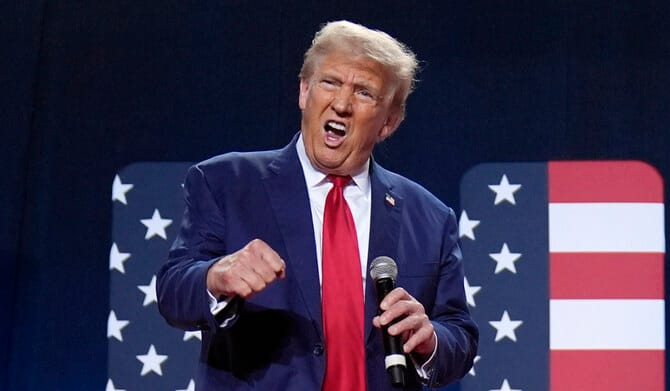
Former U.S. President Donald Trump made a provocative suggestion amid escalating tensions between Israel and Iran, stating that Israel should launch a preemptive strike on Iran’s nuclear facilities. His remarks came shortly after President Joe Biden advocated for restraint, emphasizing that an all-out war in the Middle East should be avoided. Trump, however, argued that Israel’s national security is at risk and immediate action should be prioritized over diplomacy.

Trump’s call for Israel to act was rooted in the recent missile barrage fired by Iran, which further inflamed regional tensions. He criticized Biden’s approach, suggesting that his administration’s handling of the crisis lacked decisiveness, allowing Iran to strengthen its nuclear capabilities. Trump’s statement—“hit Iran’s nuclear sites first, and worry about the rest later”—was seen as a reflection of his hardline stance on Iran, a continuation of the policies from his presidency, which included the withdrawal from the Iran nuclear deal in 2018.
Trump’s support for Israel has been a central pillar of his foreign policy, and his suggestion aligns with the long-standing strategic alliance between the two nations. Israel has been wary of Iran’s nuclear ambitions, seeing them as a direct threat, and has previously hinted at potential military action to curb Tehran’s nuclear program. Trump’s remarks may embolden Israel to consider military action, especially in light of its recent skirmishes with Iran-backed forces.
The situation in the Middle East remains tense, with global powers urging caution. Trump’s proposal risks escalating the conflict further, drawing in neighboring countries and complicating diplomatic efforts in the region. However, for many in Israel, Trump’s stance is viewed as a sign of unwavering support, contrasting Biden’s more measured approach.
As both leaders prepare for upcoming elections , their differing strategies on Israel-Iran relations are likely to become key talking points. Trump’s firm rhetoric resonates with a section of voters who prioritize a strong national defense and view Iran as a top geopolitical threat. Meanwhile, Biden’s focus remains on avoiding direct confrontation, using diplomatic channels to defuse the situation.
The ramifications of any military action against Iran would be significant, not only for Israel and Iran but also for the broader Middle East, which has seen increased instability in recent months. Trump’s suggestion may lead to further discussion within Israel’s leadership circles about how to handle the growing threat, with some factions possibly aligning with his viewpoint.
The international community is closely monitoring the situation, as any strike on Iran’s nuclear facilities could have far-reaching consequences, including disruptions to global oil supplies, increased refugee crises, and potential cyber warfare. The question remains: Will Israel heed Trump’s advice, or will it chart its own course as tensions with Iran continue to rise?














Comments 2