


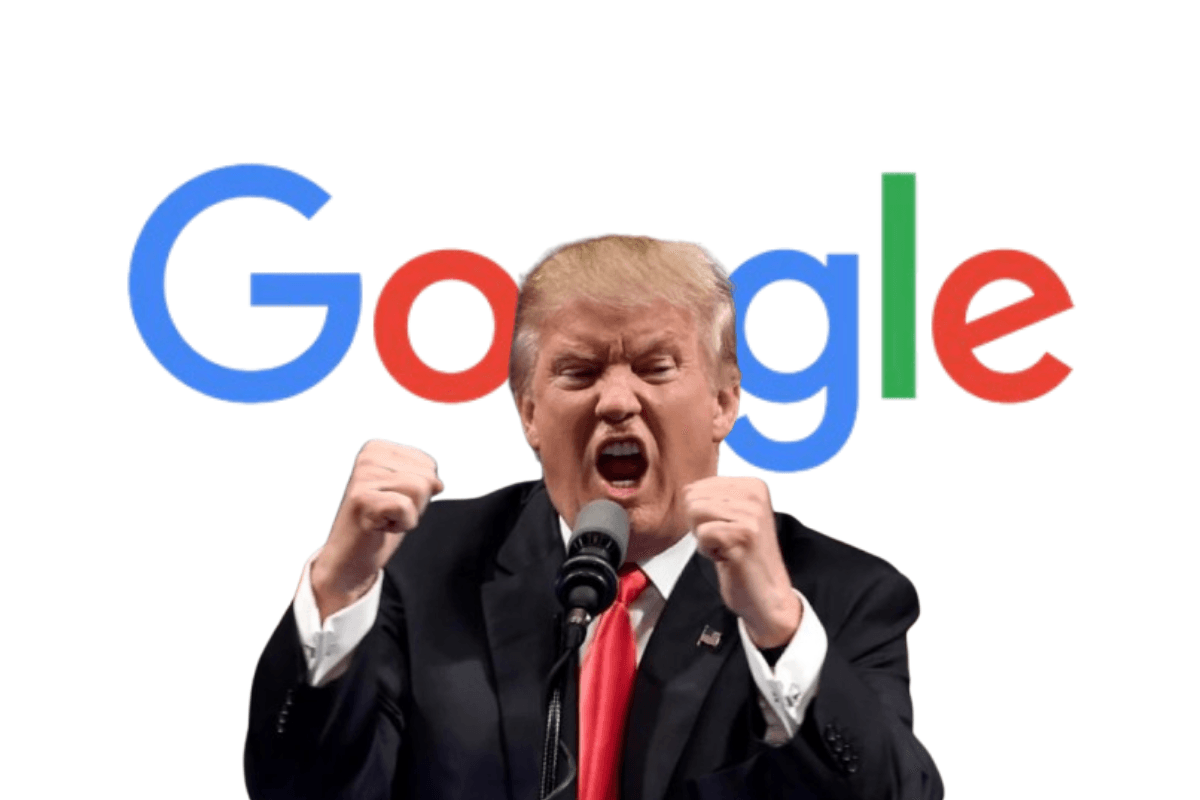
Former U.S. President Donald Trump recently announced his intention to prosecute Google if he is re-elected in the 2024 presidential election. His primary accusation centers on the claim that Google is deliberately manipulating search results to favor Democratic candidates, specifically Vice President Kamala Harris. Trump alleges that Google’s search algorithms unfairly boost positive stories about Harris while surfacing negative or less favorable articles about him, thereby interfering in the election process.

In a post shared on his social media platform, Truth Social, Trump stated that Google is part of a “crooked” system designed to influence elections. He has accused the tech giant of showing bias against him, calling it an “Election Interference Machine.” Trump further asserted that if the Department of Justice (DOJ) does not prosecute Google for this alleged behavior, he will ensure its prosecution when he regains the presidency
Background and Context
This isn’t the first time Trump has voiced concerns about Google’s practices. During his previous tenure as president, Trump repeatedly accused tech companies, including Google, of harboring political bias against conservative voices. While in office, his administration even launched investigations into Google and other tech giants like Facebook (now Meta) for alleged anti-competitive practices. However, these investigations focused more on antitrust concerns rather than the specific accusation of political bias that Trump is now pushing.
The former president’s new allegation seems to have been sparked by a report from the conservative Media Research Center, which claimed that search results on Google showed a disproportionate number of articles from left-leaning media outlets when searching for Trump and Harris. The report found that results for Harris often highlighted favorable coverage, while Trump’s campaign website ranked lower in searches
Google’s Response
Google has denied these claims, stating that their search algorithms prioritize the most relevant and current information available online. A spokesperson for Google emphasized that the company does not manipulate search results to favor any political candidate. According to Google, searches related to elections or candidates yield results that continuously evolve as new content appears online, making it impossible to maintain any deliberate bias over time.
The tech company also responded to the Media Research Center’s claims, explaining that both Trump’s and Harris’ campaign websites consistently appear among the top results for common search terms related to the 2024 presidential race. Google refuted the suggestion that they deliberately downgrade conservative websites, arguing that their algorithms are designed to provide users with the most authoritative and trustworthy sources, irrespective of political leanings.
Broader Implications
Trump’s renewed threats against Google are part of a larger narrative where he has criticized major tech companies for allegedly suppressing conservative viewpoints. This has included vocal attacks on social media platforms like Facebook and Twitter (now X), which banned Trump in the wake of the January 6 Capitol riots, citing violations of their policies. Trump’s calls for action against tech companies have resonated with a section of his supporters who believe in the existence of widespread censorship of conservative voices online.
Trump’s criticism of Google follows a pattern of the former president threatening to use federal power to address grievances with perceived enemies. In addition to tech companies, Trump has also threatened to prosecute political rivals such as Joe Biden, Kamala Harris, and Nancy Pelosi. His threats raise concerns among legal experts about the potential for a future Trump administration to weaponize the DOJ against political opponents or entities that disagree with him(AOL.com)
What Comes Next?
Trump’s rhetoric against Google aligns with his broader strategy of positioning himself as a defender against the so-called “deep state” and tech industry bias. This kind of populist messaging has proven effective among his base, many of whom view large corporations and tech companies as part of an elite structure undermining their values and interests.
However, it remains to be seen whether Trump, if re-elected, could actually initiate legal action against Google. While the DOJ under his leadership could pursue investigations, prosecuting a private company like Google for alleged election interference would be a complex legal battle. It would also likely draw significant pushback from both political and legal circles, given the absence of concrete evidence supporting claims of deliberate political bias.
In the lead-up to the 2024 election, these accusations are likely to add fuel to the ongoing debate about the role of big tech in shaping public opinion and the democratic process. While Trump’s allegations are not backed by any definitive proof at this time, his base’s perception of tech companies as antagonistic forces remains strong, further entrenching partisan divisions on this issue

















Comments 2