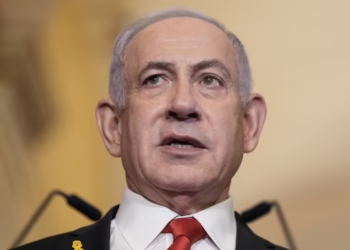



As tensions between Israel and Hezbollah continue to escalate, the prospects of a ceasefire remain uncertain. Israeli Prime Minister Benjamin Netanyahu has reiterated his commitment to using “full force” against Hezbollah, dashing hopes for an immediate halt to hostilities. Despite international pressure, particularly from the U.S. and European powers, who are pushing for a ceasefire, Netanyahu’s stance signals a prolonged conflict.

In recent weeks, Israeli airstrikes have intensified across Lebanon, targeting Hezbollah positions, including rocket launchers and command centers. These strikes have resulted in the deaths of nearly 700 people, many of whom are civilians. Lebanon’s Health Ministry has reported that women and children account for a significant portion of these casualties. Hezbollah, in retaliation, has launched hundreds of rockets into northern Israel, causing widespread damage and displacing thousands of civilians on both sides of the border.
This escalation follows the October 7 attack by Hamas, which Hezbollah has cited as the catalyst for its increased cross-border attacks on Israel. The fighting has drawn comparisons to the devastating 2006 Lebanon War, with concerns growing over the potential for an even more destructive conflict. Netanyahu has emphasized that Israel’s military actions are aimed at neutralizing Hezbollah’s military capabilities to ensure the safety of Israeli civilians living near the Lebanese border.
The international community, led by U.S. Secretary of State Antony Blinken and other world leaders, continues to advocate for a ceasefire. Diplomatic talks have been underway at the United Nations, but Hezbollah has made it clear that it would only agree to a ceasefire if Israel halts its offensive in Gaza. This condition complicates negotiations, as Israel remains focused on its broader military objectives against both Hamas and Hezbollah.
The human toll of the conflict is immense, with tens of thousands of civilians displaced in Lebanon and Israel. The Lebanese government has condemned Israel’s “systematic destruction” of border villages and called for an immediate cessation of hostilities. Foreign Minister Abdallah Bouhabib, speaking at the UN General Assembly, warned that the ongoing violence could destabilize the entire Middle East and lead to broader regional conflict.
Israel has also mobilized thousands of troops to its northern border, preparing for the possibility of a ground invasion into southern Lebanon. Hezbollah’s military capabilities, bolstered by Iranian support, present a formidable challenge for Israel’s military, raising concerns about a protracted and bloody conflict.
Despite the intense fighting, efforts to broker a ceasefire continue. However, internal political dynamics in Israel complicate the situation. Netanyahu’s far-right coalition partner, National Security Minister Itamar Ben-Gvir, has threatened to withdraw from the government if a temporary ceasefire with Hezbollah becomes permanent. This political friction further dims the prospects of a swift resolution.
Meanwhile, in the midst of the military confrontation, Israel has had to contend with missile threats from Yemen as well. This adds another layer of complexity to the already volatile situation, as the region braces for the possibility of further escalation.
As diplomatic efforts stall, the international community is watching closely, hoping for a breakthrough that could prevent further bloodshed. However, with both sides entrenched in their positions and unwilling to back down, the situation remains precarious. For now, the fighting shows no signs of abating, and the humanitarian crisis deepens by the day